Reynolds Number Calculation for Cooling Tower Water Flow
To determine the flow characteristics in the cooling tower pipe, we need to calculate the Reynolds number ($Re$). The Reynolds number helps distinguish between laminar, transitional, and turbulent flow regimes. The formula is:
$ Re = \frac{\rho v D}{\mu} $
Where:
- $ \rho $ = Density of the fluid (1000 kg m$^{-3}$)
- $ v $ = Velocity of the fluid (0.1 m s$^{-1}$)
- $ D $ = Inner diameter of the pipe (0.2 m)
- $ \mu $ = Dynamic viscosity of the fluid ($8 \times 10^{-3}$ N s m$^{-2}$)
Step-by-Step Calculation
- Substitute values: Plug the given values into the Reynolds number formula.
$ Re = \frac{(1000 \text{ kg m}^{-3}) \times (0.1 \text{ m s}^{-1}) \times (0.2 \text{ m})}{8 \times 10^{-3} \text{ N s m}^{-2}} $
- Calculate the numerator:
Numerator = $ 1000 \times 0.1 \times 0.2 = 20 $ kg m s$^{-1}$
- Calculate the Reynolds number:
$ Re = \frac{20}{8 \times 10^{-3}} = \frac{20}{0.008} $
$ Re = 2500 $
Flow Regime Determination
The calculated Reynolds number is $ Re = 2500 $. We compare this value to the standard ranges for flow regimes:
- Laminar flow: $ Re < 2300 $
- Transitional flow: $ 2300 < Re < 4000 $
- Turbulent flow: $ Re > 4000 $
Since $ Re = 2500 $ falls between 2300 and 4000, the flow is characterized as critical/transitional flow.
Important Questions from Hydrology And Water Resources
- A river with $2\text{ km}$ wide flood plain and $10\text{ m}$ channel depth flows with a velocity of $2\text{ ms}^{-1}$. What will be flow condition in the river?
Read the following statements and choose the CORRECT answer.
I. The suspended sediment concentration in rivers is supply-limited rather than hydraulically-limited, when
II. Much suspended material is contributed by overland flow from hillslope erosion
III. Suspended material is entirely derived by turbulent diffusion from the channel bed
- With reference to water in the hydrologic cycle, its residence time is the maximum in
Match the basin types A, B and C with the hydrograph patterns P, Q and R
Basin types Hydrograph pattern A. 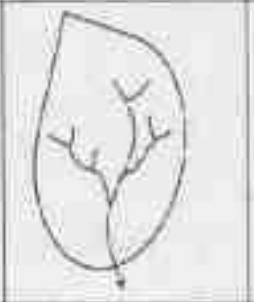
P. 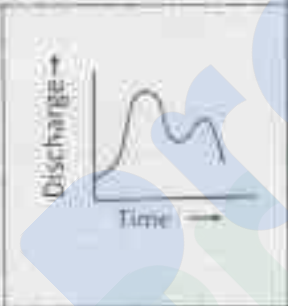
B. 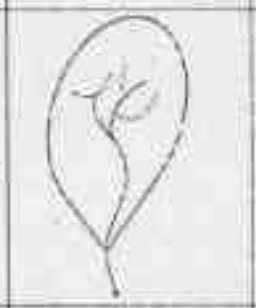
Q. 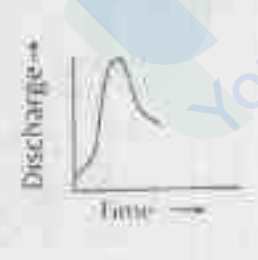
C. 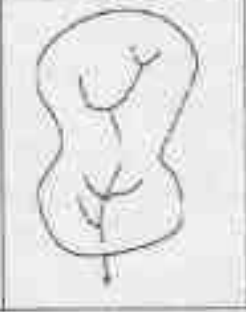
R. 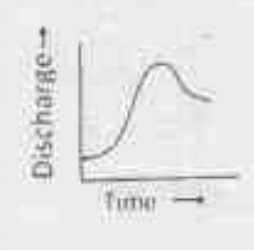
Hydraulic gradient beneath A and B during rainy and dry seasons will