
Penicillin Synthesis in Batch Culture
The synthesis of penicillin by Penicillium chrysogenum is a secondary metabolic process. Secondary metabolites are typically produced during the later stages of growth in a batch culture, after the primary growth phase.
Understanding Culture Phases
- Lag Phase: The initial phase where the microorganism adapts to the new environment. Little growth or product formation occurs.
- Exponential Phase (Log Phase): Characterized by rapid cell growth and active multiplication. Primary metabolites necessary for growth are produced.
- Stationary Phase: Cell growth slows down and eventually stops due to factors like nutrient depletion or waste accumulation. This phase is crucial for the production of secondary metabolites, including antibiotics like penicillin. The organism shifts its metabolic activity towards producing these compounds.
- Death Phase (Decline Phase): Cell viability decreases, and the number of viable cells declines. Penicillin production typically ceases or decreases significantly during this phase.
Maximum Penicillin Production
Maximum penicillin synthesis in Penicillium chrysogenum occurs during the stationary phase. This is when the organism diverts resources towards producing secondary metabolites, such as penicillin, often in response to limiting nutrients or accumulating waste products.
Important Questions from Batch Fed Batch and Continuous Processes
- Under complete cell washout condition in a chemostat with sterile feed, which of the following statements is/are correct?
A fed batch process is running at quasi-steady state with respect to substrate and biomass concentration. At $2 \text{ h}$, the culture volume is $500 \text{ L}$ with a constant sterile inlet feed at $50 \text{ L } h^{-1}$ of glucose. The culture kinetic parameters $ \mu_m$ and $K_s$ are $0.2 \text{ } h^{-1}$ and $0.1 \text{ } g \text{ } L^{-1}$, respectively.
The substrate concentration in the reactor will be ________ $g \text{ } L^{-1}$ (rounded off to one decimal place).
The following schematic diagram shows a chemostat with cell recycle
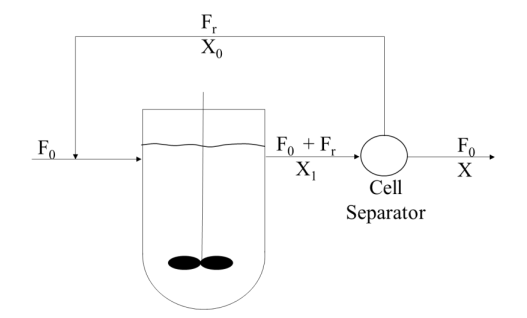
where $F_0$ and $F_r$ are the volumetric flow rates (in $L.h^{-1}$) of feed and recycle streams, respectively. $X_1$, $X_0$ and $X$ are the cell concentrations (in $g.L^{-1}$) in the reactor, recycle-stream and product-stream, respectively. If $\frac{X_0}{X_1}=1.5$, $\frac{F_r}{F_0}=0.7$ and $X_1$ is $7.3 g.L^{-1}$, the value of $X$ (in $g.L^{-1}$, rounded off to one decimal place) is ________
A $2 \text{ L}$ bioreactor is being operated as a chemostat, at a flow rate of $0.8 \text{ L/h}$ and sterile feed of $10 \text{ g/L}$ substrate. The bacterial growth follows Monod kinetics at a maximum specific growth rate of $0.6 \text{ h}^{-1}$ with a Monod constant of $0.5 \text{ g/L}$ and a biomass yield coefficient of $0.4 \text{ g/g}$. The exit biomass concentration is __________ $\text{g/L}$.
(Round off to one decimal place)
- The amount of biomass in a reactor at the end of the batch process is 50 g. Fed- batch operation is initiated by feeding the substrate solution at a constant rate of $1 \text{ L h}^{-1}$. The concentration of substrate in the feed is $50 \text{ g L}^{-1}$. The maximum biomass yield ($Y_{XS}^M$) is $0.4 \frac{\text{g biomass}}{\text{g substrate}}$. Assuming the system is at quasi-steady state, the maximum amount of biomass after 5 h of feeding is ________________ g.


