
Nucleation Energy Barrier Change Calculation
This solution explains how a change in solid-liquid interfacial energy affects the energy barrier for homogeneous nucleation.
Key Formula
The energy barrier ($G_{max}$) for homogeneous nucleation of a spherical solid nucleus is given by the formula:
$G_{max} = \frac{16 \pi \gamma^3}{3 (\Delta G_v)^2}$Where:
- $\gamma$ is the solid-liquid interfacial energy.
- $\Delta G_v$ is the change in free energy per unit volume upon solidification.
Analysis of Change
The question states that the solid-liquid interfacial energy ($\gamma$) increases by 10%. Let the initial and final values be $\gamma_1$ and $\gamma_2$, respectively. We assume $\Delta G_v$ remains constant.
Initial interfacial energy: $\gamma_1$
New interfacial energy: $\gamma_2 = \gamma_1 + 0.10 \gamma_1 = 1.10 \gamma_1$
Calculating the New Energy Barrier
Let the initial energy barrier be $G_{max,1}$ and the new energy barrier be $G_{max,2}$.
Initial barrier: $G_{max,1} = \frac{16 \pi \gamma_1^3}{3 (\Delta G_v)^2}$
New barrier: $G_{max,2} = \frac{16 \pi \gamma_2^3}{3 (\Delta G_v)^2}$ Substituting $\gamma_2 = 1.10 \gamma_1$: $G_{max,2} = \frac{16 \pi (1.10 \gamma_1)^3}{3 (\Delta G_v)^2}$ $G_{max,2} = (1.10)^3 \times \frac{16 \pi \gamma_1^3}{3 (\Delta G_v)^2}$ $G_{max,2} = (1.10)^3 \times G_{max,1}$
Calculate the cube of 1.10:
$ (1.10)^3 = 1.331 $Therefore, $G_{max,2} = 1.331 \times G_{max,1}$.
Determining the Percentage Change
The percentage change in the energy barrier is calculated as:
$ \text{Percentage Change} = \frac{G_{max,2} - G_{max,1}}{G_{max,1}} \times 100\% $ $ \text{Percentage Change} = \frac{1.331 G_{max,1} - G_{max,1}}{G_{max,1}} \times 100\% $ $ \text{Percentage Change} = \frac{(1.331 - 1) G_{max,1}}{G_{max,1}} \times 100\% $ $ \text{Percentage Change} = 0.331 \times 100\% $ $ \text{Percentage Change} = 33.1\% $The energy barrier increases by approximately 33.1%.
Conclusion
A 10% increase in solid-liquid interfacial energy results in approximately a 33.1% increase in the energy barrier for homogeneous nucleation, aligning with Option B.
Important Questions from Solidification Directional Solidification
A hypothetical binary eutectic phase diagram of A – B is shown below. An alloy with 5 wt.% B solidifies with no convection. Assuming steady state, the critical temperature gradient (in K $mm^{-1}$) required to maintain planar solidification front is: ________ (round off to nearest integer).
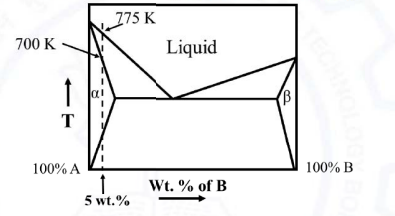
Given:
Diffusivity of B in liquid = $10^{-9}$ $m^2$ $s^{-1}$
Velocity of solidification front = 4 $\mu m$ $s^{-1}$For a solid embryo in contact with a perfectly flat mould wall as shown in the schematic, the wetting angle $\theta$ is __________ degrees.
(Round off to one decimal place).
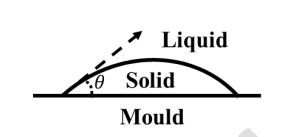
Given:
Surface tension between liquid and mould wall = $0.35 \text{ J.m}^{-2}$
Surface tension between solid and mould wall = $0.02 \text{ J.m}^{-2}$
Surface tension between liquid and solid = $0.40 \text{ J.m}^{-2}$
The constitutional undercooling condition for a hypothetical binary alloy of A with solute B during solidification is shown in the figure along with its binary phase diagram. Based on these two schematics, one can conclude that the solute concentration in region X will be _______________ the average composition of the initial liquid phase.
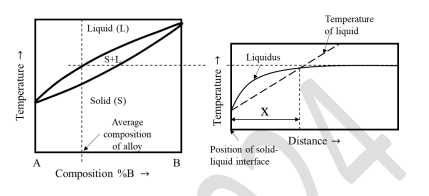
In continuous casting of steel, mould flux is used for ______________
The critical radius (in $nm$, rounded off to one decimal place) of nickel nucleus during solidification at $1673 \text{ K}$ is ________.
Given: Enthalpy of fusion of nickel = $2.65 \times 10^9 \text{ J.m}^{-3}$;
Liquid-solid interfacial energy = $0.5 \text{ J.m}^{-2}$, and
Equilibrium melting temperature of nickel = $1728 \text{ K}$.


