
If NFA of 5 states excluding the initial state is converted into DFA, maximum possible number of states for the DFA is?
64
NFA to DFA Conversion: Finding Maximum States
When we convert a Non-deterministic Finite Automaton (NFA) to a Deterministic Finite Automaton (DFA), we use a method called subset construction. This method is fundamental to understanding NFA to DFA conversion.
Understanding NFA to DFA Conversion
An NFA allows for multiple transitions from a state on the same input symbol, or even transitions without consuming an input symbol (epsilon transitions). A DFA, on the other hand, has a unique transition for each state-input pair. The NFA to DFA conversion process aims to create a DFA that accepts the same language as the original NFA.
The Subset Construction Method
The most common technique for NFA to DFA conversion is the subset construction method. In this method, each state in the resulting DFA corresponds to a set of states from the original NFA. Because a DFA state represents a collection of NFA states, the total number of possible DFA states is related to the number of subsets of the NFA states.
If an NFA has \(n\) states, the power set of its states (the set of all possible subsets of its states) has \(2^n\) elements. Each element in this power set is a potential state in the resulting DFA. Therefore, the maximum possible number of states in the converted DFA is \(2^n\), where \(n\) is the number of states in the NFA. Understanding state conversion and state transition rules is important here.
Calculating Maximum DFA States
The question specifies that the NFA has 5 states excluding the initial state. This means the total number of states in the NFA is the initial state plus the other 5 states, totaling \(1 + 5 = 6\) states. This finite automaton has 6 states in total.
Using the formula for the maximum number of states in the converted DFA:
\(\text{Maximum states in DFA} = 2^{\text{Number of states in NFA}}\)
In this case, the number of states in the NFA is 6.
\(\text{Maximum states in DFA} = 2^6\)
\(2^6 = 2 \times 2 \times 2 \times 2 \times 2 \times 2 = 64\)
Thus, the maximum possible number of states for the DFA converted from this NFA is 64. This demonstrates the power of the subset construction method in NFA to DFA conversion and how it relates to the maximum DFA states possible for a given NFA size. The state transition logic in the NFA translates to transitions between these subsets in the DFA.
Important Questions from Finite Automata
A Language for which DFA exist is a________
For a DFA accepting binary numbers whose decimal equivalent is divisible by 3, what are all the possible remainders?
Minimum Number of states require to accept string ends with 101.
Consider the DFA given below
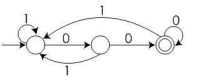
Which of the regular expressions given below represents the above DFA ?Consider the following DFA that generates set of strings over $\Sigma=\{a, b, c\}$
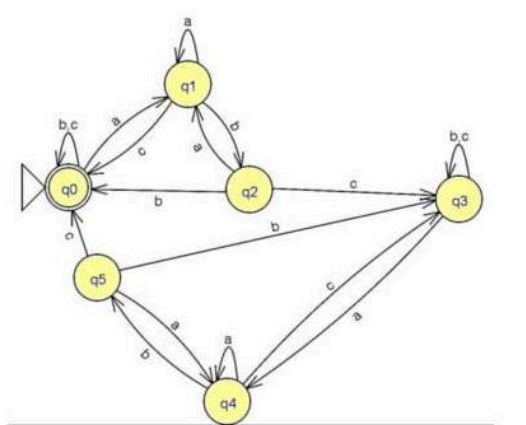
Now identify that which of the followings is the best description of the language for the above DFA


