
A Language for which DFA exist is a________
Regular Language
Understanding DFAs and Regular Languages
The question asks about the type of language for which a Deterministic Finite Automaton (DFA) exists. This delves into the fundamental relationship between automata theory and formal languages.
What is a DFA (Deterministic Finite Automaton)?
A DFA is a mathematical model of computation. It is a finite state machine that accepts or rejects a given string of input symbols by running through a sequence of states, determined by the input. A key characteristic of a DFA is that for each state and each input symbol, there is exactly one transition to another state.
- It has a finite number of states.
- It has a starting state.
- It has one or more accepting states.
- It has a transition function that dictates the next state based on the current state and input symbol.
- The computation is deterministic, meaning the next state is uniquely determined.
The Language Recognized by a DFA
In the study of Formal Languages, the set of all strings that a DFA accepts is called the language recognized by that DFA. A crucial concept in Automata Theory is the Chomsky Hierarchy, which classifies formal languages based on the type of automaton that can recognize them. The simplest class of languages in this hierarchy is the set of Regular Languages.
A fundamental theorem in Automata Theory states that the class of languages accepted by Deterministic Finite Automata is precisely the class of Regular Languages. This means if a language is regular, a DFA can be constructed to recognize it, and conversely, if a DFA exists for a language, that language is a Regular Language.
Analyzing the Options
- Regular Language: As discussed, the set of languages recognized by DFAs is exactly the set of Regular Languages. This option aligns with the core theorem of Automata Theory.
- Non - Regular Language: Non-regular languages are languages that cannot be recognized by any finite automaton, including DFAs. Examples include languages like {anbn | n ≥ 0}. These require more powerful models like Pushdown Automata.
- Any language: DFAs cannot recognize just "any language". There are many languages (like non-regular ones) that are beyond the capability of a DFA.
- Cannot be said: The relationship between DFAs and Regular Languages is well-defined and can be stated definitively.
Therefore, a language for which a Deterministic Finite Automaton (DFA) exists is by definition a Regular Language. This is a foundational concept in the field of Formal Languages and Automata Theory.
Important Questions from Finite Automata
If NFA of 5 states excluding the initial state is converted into DFA, maximum possible number of states for the DFA is?
For a DFA accepting binary numbers whose decimal equivalent is divisible by 3, what are all the possible remainders?
Minimum Number of states require to accept string ends with 101.
Consider the DFA given below
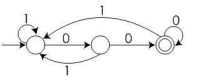
Which of the regular expressions given below represents the above DFA ?Consider the following DFA that generates set of strings over $\Sigma=\{a, b, c\}$
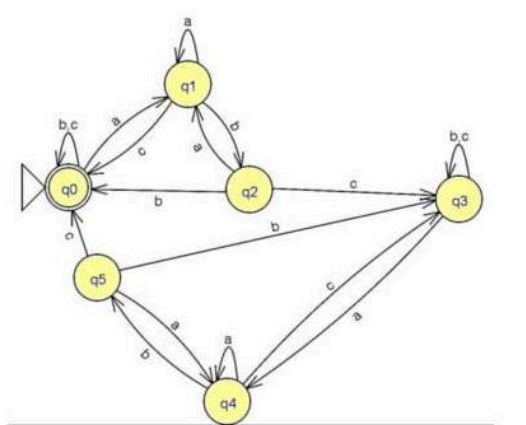
Now identify that which of the followings is the best description of the language for the above DFA


