
If KMnO4 is reduced by oxalic acid in the acidic medium, then the oxidation number of Mn changes from:
+7 to +2
Understanding Oxidation Number Change in Redox Reactions
This question asks about the change in the oxidation number of Manganese (Mn) when Potassium Permanganate (KMnO4) reacts with oxalic acid in an acidic medium. This is a classic example of a redox reaction where one species is oxidized (loses electrons, oxidation number increases) and another is reduced (gains electrons, oxidation number decreases).
Determining the Initial Oxidation State of Manganese in KMnO4
To find the initial oxidation state of Mn in KMnO4, we use the known oxidation states of Potassium (K) and Oxygen (O).
- Potassium (K) is an alkali metal, so its oxidation state is +1.
- Oxygen (O) usually has an oxidation state of -2, except in peroxides or with fluorine.
- KMnO4 is a neutral compound, so the sum of the oxidation states of all atoms is zero.
Let the oxidation state of Mn be $x$. The equation is:
$\text{Oxidation state of K} + \text{Oxidation state of Mn} + 4 \times (\text{Oxidation state of O}) = 0$
$+1 + x + 4 \times (-2) = 0$
$+1 + x - 8 = 0$
$x - 7 = 0$
$x = +7$
So, the oxidation number of Mn in KMnO4 is +7.
Manganese Reduction in Acidic Medium
Potassium Permanganate (KMnO4) contains the permanganate ion ($\text{MnO}_4^{-}$). The permanganate ion is a strong oxidizing agent, especially in acidic solution. When it acts as an oxidizing agent, it gets reduced. The product of the reduction of the permanganate ion in a strongly acidic medium is typically the Manganese(II) ion ($\text{Mn}^{2+}$).
The Manganese(II) ion ($\text{Mn}^{2+}$) has an oxidation state equal to its charge, which is +2.
Determining the Final Oxidation State of Manganese
In the reaction between KMnO4 and oxalic acid ($\text{H}_2\text{C}_2\text{O}_4$) in acidic medium, the $\text{MnO}_4^{-}$ ion is reduced to $\text{Mn}^{2+}$ ions. These $\text{Mn}^{2+}$ ions often appear as salts like Manganese(II) sulfate ($\text{MnSO}_4$) if sulfuric acid is used as the acidic medium.
Let's confirm the oxidation state of Mn in $\text{MnSO}_4$. The sulfate ion ($\text{SO}_4^{2-}$) has a charge of -2. For $\text{MnSO}_4$ to be neutral, the charge on the Mn ion must be +2.
$\text{Oxidation state of Mn} + \text{Charge of } \text{SO}_4^{2-} = 0$
$x + (-2) = 0$
$x = +2$
The oxidation number of Mn in the product is +2.
Meanwhile, the oxalic acid ($\text{H}_2\text{C}_2\text{O}_4$) is oxidized to carbon dioxide ($\text{CO}_2$). This is why KMnO4 is reduced.
Summarizing the Change in Oxidation Number
The initial oxidation number of Mn in KMnO4 is +7. The final oxidation number of Mn in the reduced product (like $\text{MnSO}_4$) is +2.
Therefore, the oxidation number of Mn changes from +7 to +2.
Balanced Chemical Equation Example
Here is a balanced chemical equation for the reaction in acidic medium (using $\text{H}_2\text{SO}_4$ as acid):
$2\text{KMnO}_4(aq) + 5\text{H}_2\text{C}_2\text{O}_4(aq) + 3\text{H}_2\text{SO}_4(aq) \rightarrow \text{K}_2\text{SO}_4(aq) + 2\text{MnSO}_4(aq) + 10\text{CO}_2(g) + 8\text{H}_2\text{O}(l)$
In this reaction:
- Mn changes from +7 (in KMnO4) to +2 (in MnSO4). It gains 5 electrons per Mn atom, so it is reduced.
- Carbon in oxalic acid ($\text{H}_2\text{C}_2\text{O}_4$) changes oxidation state. In $\text{H}_2\text{C}_2\text{O}_4$, H is +1, O is -2. $2(1) + 2x + 4(-2) = 0 \Rightarrow 2 + 2x - 8 = 0 \Rightarrow 2x = 6 \Rightarrow x = +3$. In $\text{CO}_2$, O is -2. $y + 2(-2) = 0 \Rightarrow y - 4 = 0 \Rightarrow y = +4$. Carbon changes from +3 to +4. It loses 1 electron per C atom (or 2 electrons per $\text{C}_2\text{O}_4^{2-}$ ion), so it is oxidized.
This confirms the reduction of Mn and the oxidation of oxalic acid.
Comparing with Options
The change in oxidation number of Mn is from +7 to +2. Let's look at the options:
| Option | Change in Oxidation Number |
|---|---|
| 1 | +4 to +2 |
| 2 | +6 to +4 |
| 3 | +7 to +2 |
| 4 | +7 to +4 |
Our calculated change (+7 to +2) matches Option 3.
Revision Table: Oxidation States
| Compound/Ion | Element | Oxidation State | Notes |
|---|---|---|---|
| KMnO4 | K | +1 | Alkali metal |
| KMnO4 | O | -2 | Typical oxidation state |
| KMnO4 | Mn | +7 | Calculated |
| H2C2O4 (Oxalic acid) | H | +1 | Typical oxidation state |
| H2C2O4 (Oxalic acid) | O | -2 | Typical oxidation state |
| H2C2O4 (Oxalic acid) | C | +3 | Calculated |
| MnSO4 | Mn | +2 | Product in acidic reduction of MnO4- |
| CO2 | O | -2 | Typical oxidation state |
| CO2 | C | +4 | Calculated |
Additional Information: Permanganate Reactions
The reduction product of the permanganate ion ($\text{MnO}_4^{-}$) depends on the pH of the solution:
- Strongly acidic medium (like with H2SO4): $\text{MnO}_4^{-}$ (Mn is +7) is reduced to $\text{Mn}^{2+}$ (Mn is +2). This is the most common scenario and results in a significant color change from purple (MnO4-) to colorless (Mn2+).
- Weakly acidic or neutral medium: $\text{MnO}_4^{-}$ (Mn is +7) is typically reduced to $\text{MnO}_2$ (Manganese dioxide) (Mn is +4). $\text{MnO}_2$ is a brown precipitate.
- Strongly alkaline medium: $\text{MnO}_4^{-}$ (Mn is +7) is often reduced to $\text{MnO}_4^{2-}$ (Manganate ion) (Mn is +6). The manganate ion is green. Further reduction to $\text{MnO}_2$ can occur with strong reducing agents.
In this specific question, the reaction is in an acidic medium, which confirms the reduction of Mn from +7 to +2.
Important Questions from Chemical Kinetics
A reaction takes 30 minutes to complete 50% of the reaction and takes 45 minutes to complete 75% of the reaction. The order of the reaction is:
Ferric oxide in blast furnace's upper half is mainly reduced by:
If time taken for a first-order reaction to get 90% complete is 24 min, its t99.9% will be:
Match the Items List-I and List-II:
List-I List-II (A) Instantaneous Rate (I) Rate constant (B) Average Rate (II) Rate law (C) Mathematical expression for rate of reaction in terms of concentration of reactants (III) Short interval of time (D) Rate of reaction for zero-order reaction is equal to (IV) Long direction of time Choose the correct answer from the options given below:
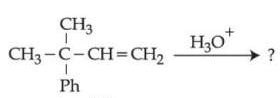 product formed is:


