
Code Analysis from Examples
The question presents a coding puzzle where words are represented by sequences of numbers. We are given two examples: HIDE coded as 19-23-7-11 and CAGE coded as 5-2-17-11. Our task is to determine the code for the word HIGH based on these examples.
First, let's list the provided word-code pairs:
- HIDE → 19-23-7-11
- CAGE → 5-2-17-11
Letter Code Mappings
To solve this, we need to identify the pattern used to convert letters into numbers. By examining the examples, we can deduce the specific code assigned to each unique letter.
From the word HIDE:
- H is coded as 19
- I is coded as 23
- D is coded as 7
- E is coded as 11
From the word CAGE:
- C is coded as 5
- A is coded as 2
- G is coded as 17
- E is coded as 11
Notice that the letter E appears in both words and consistently maps to the code 11. This suggests a direct substitution cipher where each letter has a fixed numerical code.
We can summarize these established mappings:
| Letter | Assigned Code |
|---|---|
| H | 19 |
| I | 23 |
| D | 7 |
| E | 11 |
| C | 5 |
| A | 2 |
| G | 17 |
Applying Code to HIGH
Now we apply these derived letter codes to find the code for the word HIGH. The word HIGH consists of the letters H, I, G, and H.
- For the first letter H, the code is 19.
- For the second letter I, the code is 23.
- For the third letter G, the code is 17.
- For the fourth letter H, the code is 19.
Combining these codes in sequence gives us the final code for HIGH.
Final Code Determination
Based on the established letter-to-number mappings from the examples HIDE and CAGE, the word HIGH is coded as follows:
19-23-17-19
This sequence represents the code for HIGH.
Important Questions from Coding Decoding
- If IMAGE and FIELD are coded as FHBNJ and EMFJG respectively then, which one among the given options is the most appropriate code for BEACH ?
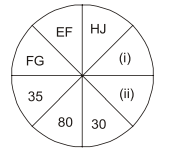
In the given figure, EF and HJ are coded as 30 and 80, respectively. Which one among the given options is most appropriate for the entires marked (i) and (ii)?
Examine the given data. The value of X is ________ (in integer).
Hint: Onset clusters are not allowed in the language.12 buzbi 20 bizbu 22 bizbuzbi 13 busti X tizbuzbi - P, Q, R and S are to be uniquely coded using $\alpha$ and $\beta$. If P is coded as $\alpha\alpha$ and Q as $\alpha\beta$, then R and S, respectively, can be coded as
If IMHO = JNIP; IDK = JEL; and SO = TP, then IDC = _____.


