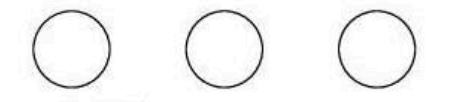
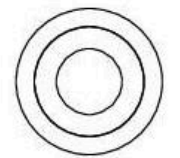
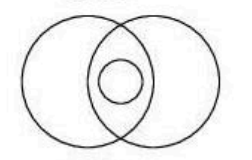
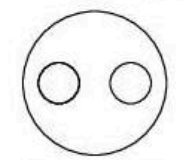
A. Total mass of positron and electron is equivalent to 1.02 MeV
B. Nucleus or material is not needed for pair annihilation.
C. For pair production maximum photon wavelength is 1.2 pm.
D. Pair production can occur in empty space.
E. Nucleus or material is not needed for pair production.
Choose the correct answer from the options given below:
Analyzing Statement A: Electron Positron Mass Equivalence
The rest mass energy of an electron is approximately $0.511$ MeV. Its antiparticle, the positron, has the same rest mass energy.
The total rest mass energy for an electron-positron pair is the sum of their individual rest mass energies:
Total Energy $= m_e c^2 + m_p c^2 \approx 0.511 \text{ MeV} + 0.511 \text{ MeV} = 1.022 \text{ MeV}$
This value is commonly approximated as $1.02$ MeV. Therefore, statement A is correct.
Analyzing Statement B: Nucleus Role in Pair Annihilation
Pair annihilation is the process where a particle and its antiparticle (e.g., an electron and a positron) collide and convert their mass into energy, typically producing photons ($e^+ + e^- \rightarrow \gamma + \gamma$).
While a nucleus can facilitate momentum conservation in specific scenarios (like single-photon annihilation), it is not fundamentally required for the annihilation process itself. Statement B is correct.
Analyzing Statement C: Maximum Photon Wavelength for Pair Production
Pair production requires a minimum photon energy ($E_{min}$) equal to the combined rest mass energy of the electron-positron pair, which is approximately $1.022$ MeV.
The energy ($E$) and wavelength ($\lambda$) of a photon are related by $E = \frac{hc}{\lambda}$, where $h$ is Planck's constant and $c$ is the speed of light. The maximum wavelength ($\lambda_{max}$) corresponds to the minimum energy ($E_{min}$):
$\lambda_{max} = \frac{hc}{E_{min}}$
Using $h \approx 6.626 \times 10^{-34}$ J·s, $c \approx 3 \times 10^8$ m/s, and $E_{min} \approx 1.022 \text{ MeV} \approx 1.636 \times 10^{-13}$ J:
$\lambda_{max} \approx \frac{(6.626 \times 10^{-34} \text{ J·s}) \times (3 \times 10^8 \text{ m/s})}{1.636 \times 10^{-13} \text{ J}} \approx 1.215 \times 10^{-12} \text{ m}$
This value is approximately $1.2$ pm (picometers). Thus, statement C is correct.
Analyzing Statement D: Pair Production in Empty Space
Pair production requires the conservation of both energy and momentum. A single photon interacting in empty space cannot create an electron-positron pair because momentum conservation cannot be satisfied without interaction with another particle or field (like a nucleus) to absorb momentum. Statement D is incorrect.
Analyzing Statement E: Necessity of Nucleus for Pair Production
As explained for statement D, a nucleus or similar interacting particle is necessary for pair production to conserve momentum. Therefore, statement E is incorrect.
Conclusion on Correct Statements
Statements A, B, and C are correct based on the analysis of fundamental physics principles governing pair production and annihilation.
- Statement A: Correct.
- Statement B: Correct.
- Statement C: Correct.
- Statement D: Incorrect.
- Statement E: Incorrect.
The combination of correct statements is A, B, and C.
Similar Questions
- A solution containing 8.3 per dm$^3$ of Urea (molar mass = 60 g mol$^{-1}$) if found to be isotonic with 5% solution of non volatile organic solute A. The approximate molar mass of A is
- Choose the correct statement about para & ortho Hydrogen
A. Total spin of ortho hydrogen is zero.
B. Total spin of para hydrogen is zero.
C. The physical properties of two forms are different.
D. The chemical properties of two forms are different.
E. At higher temperature ortho is more stable.
Choose the correct answer from the options given below: - The root mean square velocity of a gas is given by
- Given below are two statements: one is labelled as Assertion A and the other is labelled as Reason R
Assertion A: Mass and volume are extensive properties.
Reason R: The ratio of mass to volume is also an extensive property.
In the light of the above statements, choose the most appropriate answer from the options given below - The parameters of Unit Cell in Hexagonal Crystal System is
- Cold light emission by glow worms is an example of
- In Cu atom $Z_{\text{eff}}$ value for 3d & 4s $e^-$ are respectively
- The molar conductance of NH$_4$Cl, NH$_4$NO$_3$ and AgNO$_3$ at infinite dilution are x, y & z Sm$^2$ mol$^{-1}$ respectively. The molar conductance of AgCl at infinite dilution is
- Which of the following has highest spin only magnetic moment.
- Match the LIST-I with LIST-II
LIST-I LIST-II A. Alkaline Earth metals I. s - block B. Transition Elements II. p - block C. Transuranic Elements III. d - block D. Metalloid IV. f - block
Choose the correct answer from the options given below:
Important Questions from Mixed Topic (CUET PG)
- Kalpsutra, the illustrated canonical text is from:-
- The Harappan city almost exclusively devoted to craft production was-:
- Mohandas Karamchand Gandhi launched quit India movement after the failure of:-
- The "Objectives Resolution" was introduced in constituent assembly by:-
- Who among the following was not a member of the constituent assembly:-