How many squares are there in the given figure?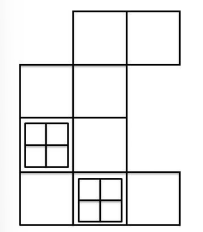
Let's calculate the total number of squares present in the given figure step-by-step.
To systematically count the number of squares, we consider squares of different sizes.
- Count the smallest squares (1x1):
- There are 4 smallest squares within the top-left block.
- Another 4 smallest squares within the middle block.
- There are 6 separate small squares around the structure.
- Total = 4 + 4 + 6 = 14 squares of size 1x1.
- Count the medium squares (2x2):
- There is 1 medium square inside each 4x4 structure (top-left and center), contributing 2 squares.
- Additionally, other 2x2 squares can form using combinations of the 1x1 squares surrounding these blocks.
- Total = 2 (inside the 4x4 blocks) + 3 (from surrounding combinations) = 5 squares of size 2x2.
- Count the large squares (3x3 and 4x4):
- There are no 3x3 squares because such combinations cannot form given the structure.
- There are 2 squares of 4x4 size (considering combinations of 4 2x2 squares).
- Total = 2 squares of size 4x4.
So, adding up all the different squares we have:
- Total = 14 (1x1) + 5 (2x2) + 2 (4x4) = 21 squares.
Thus, the total number of squares in the given figure is 21. The correct answer is 21.
Important Questions from Analytical Aptitude
- The assumption that the probability of occurrence of a word in a string depends ONLY on the preceding word is called a ______ assumption.
- Which ONE of the following options represents the correct mapping of the phonetic features in Column X to their Sanskrit equivalents in Column Y?
Column X:
Phonetic featuresColumn Y:
Sanskrit termsP. voicing 1. prāṇa Q. retroflex 2. tālavya R. palatal 3. ghōṣa S. aspiration 4. mūrdhanya - Which ONE of the options represents the CORRECT mapping between the morphological concepts in Column X and the examples in Column Y?
Column X:
Morphological ConceptsColumn Y:
ExamplesP. Suppletion 1. bookmaker – bookie Q. Conversion 2. deer – deer R. Zero morpheme 3. bad – worst S. Hypocorism 4. arrive – arrival T. Derivation 5. (a) doctor – (to) doctor 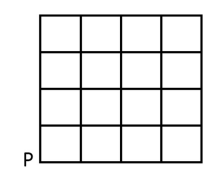
An ant is at the bottom-left corner of a grid (point P) as shown above. It aims to move to the top-right corner of the grid. The ant moves only along the lines marked in the grid such that the current distance to the top-right corner strictly decreases.
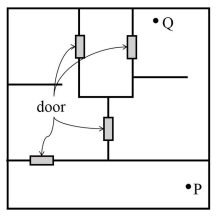
Which one of the following is a part of a possible trajectory of the ant during the movement?A building has several rooms and doors as shown in the top view of the building given below. The doors are closed initially.
What is the minimum number of doors that need to be opened in order to go from the point P to the point Q?