
Giffen Paradox Definition
The Giffen paradox describes a situation where the demand for a good increases as its price increases, contradicting the standard law of demand.
Income and Substitution Effects
When the price of a good changes, it affects consumer purchasing power (income effect) and the relative attractiveness of the good compared to others (substitution effect).
- Substitution Effect: When the price of a good rises, it becomes relatively more expensive than other goods. Consumers tend to substitute away from the expensive good towards cheaper alternatives. This effect always leads to buying less of the good whose price increased.
- Income Effect: When the price of a good rises, the consumer's real income (purchasing power) decreases.
- For normal goods, a decrease in real income leads to buying less.
- For inferior goods, a decrease in real income leads to buying more.
Condition for Giffen Paradox
A Giffen good is a special type of inferior good. For the Giffen paradox to occur, the quantity demanded must increase when the price increases. This happens specifically when:
The negative income effect (where consumers buy more of the inferior good as their real income falls due to a price rise) is stronger than the substitution effect (where consumers buy less of the good as it becomes relatively more expensive).
Therefore, the Giffen paradox occurs when the income effect is negative and greater in magnitude than the substitution effect.
Answer Justification
Option 4 correctly states that the Giffen paradox occurs when the income effect is negative and greater than the substitution effect. This unique condition allows demand to move in the same direction as price for certain inferior goods.
Important Questions from Consumer behaviour
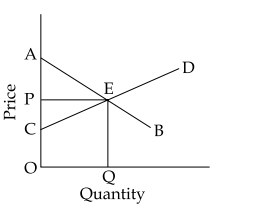
In the above diagram, the consumer surplus is represented by the area of :
- Organization responsible for preventing unfair or deceptive trade practices in textile and textile products is :
- The urge to possess and consume for display of wealth is called :
- Which of the following factors favour fashion ?
(a) Leisure
(b) An economy of abundance
(c) Transportation and communication
(d) Low income
(e) Sumptuary laws
Code : - Arrange the following Acts in the ascending order of their years of enactment :
(a) Environmental Protection Act
(b) MRTP
(c) PFA
(d) ISI Certification Marks Act
(e) Air Pollution Act


