
P says: "Q is guilty."
Q says: "R is guilty."
R says: "P is innocent."
S says: "I am innocent"
If it is known that exactly one of them is guilty, and only the guilty person lies (all innocent people tell the truth), then who is the guilty one?
Understanding the Theft Case Scenario
This problem involves a theft case with four suspects: P, Q, R, and S. We are given specific statements made by each suspect and two crucial conditions:
- Condition 1: Exactly one of the four suspects is guilty.
- Condition 2: Innocent people always tell the truth, and the guilty person always lies.
Our goal is to use these statements and conditions to identify the guilty person.
Analyzing Suspect Statements and Conditions
We need to examine each suspect as the potential guilty person and check if the statements and conditions hold true. Let's analyze each possibility:
Case 1: Assuming P is Guilty
If P is the guilty person:
- P lies. P's statement is "Q is guilty." Since P is lying, this means Q is innocent.
- Since only one person is guilty, Q, R, and S must be innocent.
- Q (innocent) tells the truth. Q's statement is "R is guilty." This implies R is guilty.
- This leads to a contradiction: we assumed only P is guilty, but we deduced R is also guilty. Therefore, P cannot be the guilty person.
Case 2: Assuming Q is Guilty
If Q is the guilty person:
- Q lies. Q's statement is "R is guilty." Since Q is lying, this means R is innocent.
- Since only one person is guilty, P, R, and S must be innocent.
- P (innocent) tells the truth. P's statement is "Q is guilty." This matches our assumption that Q is guilty.
- R (innocent) tells the truth. R's statement is "P is innocent." This matches the deduction that P is innocent.
- S (innocent) tells the truth. S's statement is "I am innocent." This matches the deduction that S is innocent.
- All conditions are satisfied: Q is the single guilty person, Q lies, and P, R, and S tell the truth. This scenario is consistent.
Case 3: Assuming R is Guilty
If R is the guilty person:
- R lies. R's statement is "P is innocent." Since R is lying, this means P is guilty.
- This leads to a contradiction: we assumed only R is guilty, but we deduced P is also guilty. Therefore, R cannot be the guilty person.
Case 4: Assuming S is Guilty
If S is the guilty person:
- S lies. S's statement is "I am innocent." Since S is lying, this means S is guilty. This part is consistent with the assumption.
- Since only one person is guilty, P, Q, and R must be innocent.
- P (innocent) tells the truth. P's statement is "Q is guilty." This implies Q is guilty.
- This leads to a contradiction: we assumed only S is guilty, but we deduced Q is also guilty. Therefore, S cannot be the guilty person.
Conclusion: Determining the Guilty Party
By analyzing each possibility, we found that only the assumption 'Q is guilty' satisfies all the given conditions. In this case:
- Q is guilty and lies (Statement: "R is guilty" - False).
- P is innocent and tells the truth (Statement: "Q is guilty" - True).
- R is innocent and tells the truth (Statement: "P is innocent" - True).
- S is innocent and tells the truth (Statement: "I am innocent" - True).
Therefore, the guilty person is Q.
Important Questions from Puzzle (Notes)
- There are five men - A, B, C, D and E, six women P, Q, R, S, T and Z. A, B, and R are advocates. S, Q, P, D and C are doctors and the rest are teachers. A team has to be selected from these eleven persons subject to the following conditions:
(I) A, P and Z have to be together.
(II) B cannot go with D or R.
(III) E and Q have to be together.
(IV) C and T have to be together.
(V) D and P cannot go together.
(VI) C cannot go with Q.
If the team formed consists of two male advocates, two lady doctors and one teacher, the members of the team can be: - Read the following informations and answer the question given below :
A total of nine cards consisting of four kings, four queens and one joker are distributed among three persons P, Q and R such as :
I. Q has two cards, P has three cards and R has four cards.
II. Person, who has maximum number of cards, does not have the joker.
III. Each one has atleast one king while Q has two kings.
Who has three queens ? Consider the following information regarding a 3-digit PIN.
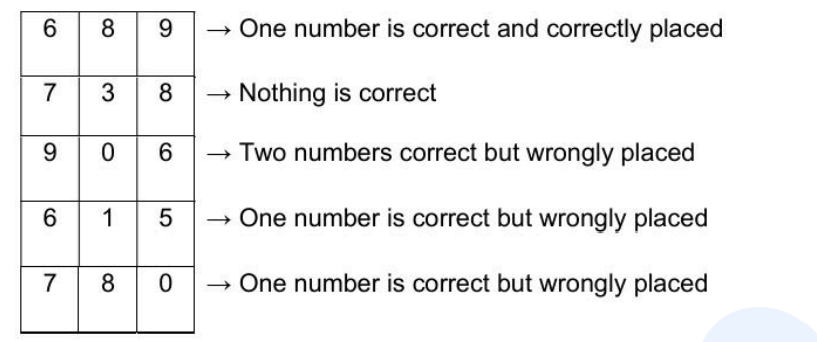
The correct PIN is- A boatman on a bank of a river has to carry a dog, a cat and a container full of milk to the other bank in a boat, one at a time. The cat cannot be left alone with the milk or with the dog on either bank. What is the minimum number of times the boatman has to cross the river to carry all to the other bank?
- How many minimum number of times water must be poured from a fully filled vessel of 12 litre capacity to an empty vessel of 8 litre capacity to transfer 6 litres of water while an empty vessel of 5 litre capacity is also available for use?


