
For the reaction \( x + y \rightarrow z \), rate law expression is rate = \( k[x][y]^3 \). If the volume of the vessel is reduced to \( \frac{1}{3} \) of its original volume, then the rate of reaction will:
increase 81 times.
Understanding Reaction Rate and Volume Change
The rate of a chemical reaction is often dependent on the concentrations of the reactants. This relationship is described by the rate law expression.
For the given reaction \( x + y \rightarrow z \), the rate law expression is provided as:
\( \text{rate} = k[x][y]^3 \)
Here, \( k \) is the rate constant, \( [x] \) is the concentration of reactant \( x \), and \( [y] \) is the concentration of reactant \( y \). The exponents of the concentrations in the rate law (\( 1 \) for \( [x] \) and \( 3 \) for \( [y] \)) represent the order of the reaction with respect to each reactant. The overall order of the reaction is the sum of these exponents, which is \( 1 + 3 = 4 \).
Effect of Volume Reduction on Concentration
Concentration is defined as the amount of substance (moles) per unit volume. Mathematically, concentration \( C \) is given by:
\( C = \frac{\text{moles}}{\text{Volume}} \)
If the amount of substance (moles) remains constant, changing the volume of the vessel will directly affect the concentration. In this problem, the volume of the vessel is reduced to \( \frac{1}{3} \) of its original volume.
Let the original volume be \( V_1 \) and the original concentrations be \( [x]_1 \) and \( [y]_1 \). The original moles of \( x \) and \( y \) are \( n_x \) and \( n_y \), respectively.
- Original concentration of x: \( [x]_1 = \frac{n_x}{V_1} \)
- Original concentration of y: \( [y]_1 = \frac{n_y}{V_1} \)
The new volume is \( V_2 = \frac{1}{3} V_1 \). The moles of \( x \) and \( y \) remain \( n_x \) and \( n_y \).
- New concentration of x: \( [x]_2 = \frac{n_x}{V_2} = \frac{n_x}{\frac{1}{3} V_1} = 3 \frac{n_x}{V_1} = 3[x]_1 \)
- New concentration of y: \( [y]_2 = \frac{n_y}{V_2} = \frac{n_y}{\frac{1}{3} V_1} = 3 \frac{n_y}{V_1} = 3[y]_1 \)
So, reducing the volume to one-third increases the concentration of both reactants by a factor of 3.
Calculating the New Rate of Reaction
Now we can use the rate law expression to find the new rate of reaction with the new concentrations.
Original rate: \( \text{rate}_1 = k[x]_1[y]_1^3 \)
New rate: \( \text{rate}_2 = k[x]_2[y]_2^3 \)
Substitute the new concentrations \( [x]_2 = 3[x]_1 \) and \( [y]_2 = 3[y]_1 \) into the new rate expression:
\( \text{rate}_2 = k (3[x]_1) (3[y]_1)^3 \)
\( \text{rate}_2 = k (3[x]_1) (3^3 [y]_1^3) \)
\( \text{rate}_2 = k (3[x]_1) (27 [y]_1^3) \)
Now, rearrange the terms:
\( \text{rate}_2 = (3 \times 27) \times k[x]_1[y]_1^3 \)
\( \text{rate}_2 = 81 \times (k[x]_1[y]_1^3) \)
Since \( \text{rate}_1 = k[x]_1[y]_1^3 \), we can replace the term in the parenthesis:
\( \text{rate}_2 = 81 \times \text{rate}_1 \)
This shows that the new rate of reaction (\( \text{rate}_2 \)) is 81 times the original rate of reaction (\( \text{rate}_1 \)). Therefore, the rate of reaction will increase 81 times.
Analysis of Options
Let's examine the given options based on our calculation:
- decrease 81 times: This is incorrect as the rate increased.
- increase 81 times: This matches our calculation.
- decrease 9 times: This is incorrect.
- increase 27 times: This is incorrect.
Conclusion
When the volume of the vessel is reduced to \( \frac{1}{3} \) of its original volume, the concentrations of reactants \( x \) and \( y \) increase by a factor of 3. Based on the rate law \( \text{rate} = k[x][y]^3 \), the new rate is \( k(3[x])(3[y])^3 = k(3[x])(27[y]^3) = 81k[x][y]^3 \), which is 81 times the original rate. Thus, the rate of reaction will increase 81 times.
| Initial Conditions | Effect of Volume Reduction | Final Conditions |
|---|---|---|
| Volume = \( V_1 \) | Volume becomes \( V_2 = V_1/3 \) | Volume = \( V_1/3 \) |
| Concentration \( [x]_1 \) | Concentration \( [x] \) increases by \( 3 \) | Concentration \( [x]_2 = 3[x]_1 \) |
| Concentration \( [y]_1 \) | Concentration \( [y] \) increases by \( 3 \) | Concentration \( [y]_2 = 3[y]_1 \) |
| Initial Rate \( \text{rate}_1 = k[x]_1[y]_1^3 \) | Rate changes based on new concentrations | Final Rate \( \text{rate}_2 = k[x]_2[y]_2^3 = k(3[x]_1)(3[y]_1)^3 = 81 \times \text{rate}_1 \) |
Revision Table: Reaction Rate & Volume Change
| Concept | Description | Relevance to Problem |
|---|---|---|
| Rate Law | Mathematical expression relating reaction rate to reactant concentrations. | Given as \( \text{rate} = k[x][y]^3 \). Essential for calculating rate change. |
| Concentration | Moles of substance per unit volume. | Directly affected by changes in reaction vessel volume. |
| Effect of Volume on Concentration | Reducing volume increases concentration; increasing volume decreases concentration (if moles are constant). | Volume reduced to 1/3 means concentrations increase by 3 times. |
| Reaction Order | Sum of exponents in the rate law (\(1+3=4\) in this case). | Determines how strongly rate is affected by concentration changes. A higher order leads to a greater rate change for a given concentration change. |
Additional Information: Factors Affecting Reaction Rate
Besides the concentration of reactants (which is affected by volume in gaseous or solution phase reactions), several other factors influence the rate of a chemical reaction:
- Temperature: Increasing temperature usually increases reaction rate because molecules have more kinetic energy, leading to more frequent and energetic collisions.
- Presence of Catalyst: A catalyst speeds up a reaction without being consumed by providing an alternative reaction pathway with lower activation energy.
- Surface Area: For reactions involving solids, increasing the surface area exposed to reactants increases the reaction rate.
- Pressure: For gaseous reactions, increasing the pressure increases the concentration of gas molecules, similar to reducing volume, thus increasing the reaction rate.
- Nature of Reactants: The chemical properties of the reactants themselves influence how fast they react.
Understanding these factors is crucial for controlling the speed of chemical processes in various applications.
Important Questions from Chemical Kinetics
A reaction takes 30 minutes to complete 50% of the reaction and takes 45 minutes to complete 75% of the reaction. The order of the reaction is:
Ferric oxide in blast furnace's upper half is mainly reduced by:
If time taken for a first-order reaction to get 90% complete is 24 min, its t99.9% will be:
Match the Items List-I and List-II:
List-I List-II (A) Instantaneous Rate (I) Rate constant (B) Average Rate (II) Rate law (C) Mathematical expression for rate of reaction in terms of concentration of reactants (III) Short interval of time (D) Rate of reaction for zero-order reaction is equal to (IV) Long direction of time Choose the correct answer from the options given below:
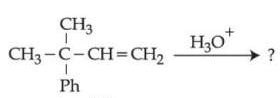 product formed is:


