
Molar conductivity values of the solutions of strong electrolyte AB at $18^{\circ}\text{C}$ are given below :$\text{c } [\text{mol L}^{-1}]$ $0.04$ $0.09$ $0.16$ $0.25$ $\Lambda_{\text{m}} \ [\text{S cm}^{2}\text{ mol}^{-1}]$ $96.1$ $95.7$ $95.3$ $94.9$
The value of constant A based on the above data $[\text{in S cm}^{2}\text{ mol}^{-1} / (\text{mol}/\text{L})^{1/2}]$ unit is _________.
Calculating Electrolyte Constant A
The molar conductivity ($\Lambda_{\text{m}}$) of a strong electrolyte is related to its concentration ($c$) by the Debye-Hückel-Onsager equation: $ \Lambda_{\text{m}} = \Lambda_{\text{m}}^{\circ} - \text{A}c^{1/2} $ Here, $\Lambda_{\text{m}}^{\circ}$ is the molar conductivity at infinite dilution, and $\text{A}$ is a constant specific to the electrolyte, solvent, and temperature ($18^{\circ}\text{C}$ in this case).
This equation indicates a linear relationship between $\Lambda_{\text{m}}$ and $c^{1/2}$. Rearranging the equation, we get: $ \Lambda_{\text{m}} = -\text{A}c^{1/2} + \Lambda_{\text{m}}^{\circ} $ This represents the equation of a straight line ($y = mx + b$), where $y = \Lambda_{\text{m}}$, $x = c^{1/2}$, the slope $m = -\text{A}$, and the y-intercept $b = \Lambda_{\text{m}}^{\circ}$.
Data Table and Calculations
| Concentration, $c$ [mol L-1] | $\sqrt{c}$ [(mol L-1)1/2] | Molar Conductivity, $\Lambda_{\text{m}}$ [S cm2 mol-1] |
|---|---|---|
| 0.04 | $\sqrt{0.04} = 0.2$ | 96.1 |
| 0.09 | $\sqrt{0.09} = 0.3$ | 95.7 |
| 0.16 | $\sqrt{0.16} = 0.4$ | 95.3 |
| 0.25 | $\sqrt{0.25} = 0.5$ | 94.9 |
Determining Constant A
The constant $\text{A}$ can be found from the slope of the $\Lambda_{\text{m}}$ versus $c^{1/2}$ plot. The slope ($m$) is equal to $-\text{A}$. We calculate the slope using pairs of points from the table:
- Using points (0.2, 96.1) and (0.3, 95.7):
Since the slope $m = -\text{A}$:
$ -\text{A} = -4 $ $ \text{A} = 4 \text{ S cm}^2 \text{ mol}^{-1} / (\text{mol L}^{-1})^{1/2} $The value of constant A calculated from the data is 4.
Similar Questions
- X and Y are the number of electrons involved, respectively during the oxidation of $\text{I}^-$ to $\text{I}_2$ and $\text{S}^{2-}$ to S by acidified $\text{K}_2\text{Cr}_2\text{O}_7$. The value of X + Y is ______.
- Consider two Group IV metal ions $\text{X}^{2+}$ and $\text{Y}^{2+}$.
A solution containing 0.01 M $\text{X}^{2+}$ and 0.01 M $\text{Y}^{2+}$ is saturated with $\text{H}_2\text{S}$. The pH at which the metal sulphide YS will form as a precipitate is ______. (Nearest integer)
(Given: $\text{K}_{sp}(\text{XS}) = 1 \times 10^{-22}$ at $25^\circ\text{C}$, $\text{K}_{sp}(\text{YS}) = 4 \times 10^{-16}$ at $25^\circ\text{C}$, $[\text{H}_2\text{S}] = 0.1\text{M}$ in solution, $\text{K}_{a1} \times \text{K}_{a2}(\text{H}_2\text{S}) = 1.0 \times 10^{-21}$, $\log 2 = 0.30$, $\log 3 = 0.48$, $\log 5 = 0.70$) - Electricity is passed through an acidic solution of $\text{Cu}^{2+}$ till all the $\text{Cu}^{2+}$ was exhausted, leading to the deposition of 300 mg of Cu metal. However, a current of 600 mA was continued to pass through the same solution for another 28 minutes by keeping the total volume of the solution fixed at 200 mL. The total volume of oxygen evolved at STP during the entire process is ______ mL. (Nearest integer)
[Given:
$\text{Cu}^{2+}\text{(aq)} + 2\text{e}^- \rightarrow \text{Cu(s)} \quad \text{E}^\circ_{\text{red}} = +0.34 \text{ V}$
$\text{O}_2\text{(g)} + 4\text{H}^+ + 4\text{e}^- \rightarrow 2\text{H}_2\text{O} \quad \text{E}^\circ_{\text{red}} = +1.23 \text{ V}$
Molar mass of Cu = $63.54 \text{ g mol}^{-1}$
Molar mass of $\text{O}_2$ = $32 \text{ g mol}^{-1}$
Faraday Constant = $96500 \text{ C mol}^{-1}$
Molar volume at STP = 22.4 L] - The half-life of ${}^{65}\text{Zn}$ is 245 days. After x days, 75% of original activity remained. The value of $x$ in days is _______. (Nearest integer)
(Given: $\log 3 = 0.4771$ and $\log 2 = 0.3010$) - Molar conductivity of a weak acid HQ of concentration $0.18 \text{ M}$ was found to be $1/30$ of the molar conductivity of another weak acid HZ with concentration of $0.02 \text{ M}$. If $\lambda^\circ_{Q^-}$ happened to be equal with $\lambda^\circ_{Z^-}$, then the difference of the $\text{pK}_a$ values of the two weak acids ($\text{pK}_a\text{(HQ)} - \text{pK}_a\text{(HZ)}$) is _______ (Nearest integer).
[Given: degree of dissociation ($\alpha$) < < 1 for both weak acids, $\lambda^\circ$ : limiting molar conductivity of ions] - The first and second ionization constants of $\text{H}_2\text{X}$ are $2.5 \times 10^{-8}$ and $1.0 \times 10^{-13}$ respectively. The concentration of $\text{X}^{2-}$ in $0.1\text{ M}$ $\text{H}_2\text{X}$ solution is __________ $\times 10^{-15}\text{ M}$. (Nearest Integer)
- The osmotic pressure of a living cell is $12\text{ atm}$ at $300\text{ K}$. The strength of sodium chloride solution that is isotonic with the living cell at this temperature is __________ $\text{g L}^{-1}$. (Nearest integer)
Given : $\text{R} = 0.08\text{ L atm K}^{-1}\text{ mol}^{-1}$
Assume complete dissociation of $\text{NaCl}$
(Given : Molar mass of $\text{Na}$ and $\text{Cl}$ are $23$ and $35.5\text{ g mol}^{-1}$ respectively.) - $MX$ is a sparingly soluble salt that follows the given solubility equilibrium at $298\text{ K}$.
$\text{MX (s)} \rightleftharpoons \text{M}^+\text{ (aq)} + \text{X}^-\text{ (aq)}; \quad \text{K}_{\text{sp}} = 10^{-10}$
If the standard reduction potential for $\text{M}^+\text{(aq)} \xrightarrow{+\text{e}^-} \text{M(s)}$ is $\left(\text{E}^\ominus_{\text{M}^+/\text{M}}\right) = 0.79\text{ V}$, then the value of the standard reduction potential for the metal/metal insoluble salt electrode $\text{E}^\ominus_{\text{X}^-/\text{MX (s)}/\text{M}}$ is __________ $\text{mV}$. (nearest integer)
[Given : $\frac{2.303\text{ RT}}{\text{F}} = 0.059\text{ V}$] - $\text{A} \longrightarrow \text{B} \text{ (first reaction)}$
$\text{C} \longrightarrow \text{D} \text{ (second reaction)}$
Consider the above two first-order reactions. The rate constant for first reaction at $500\text{ K}$ is double of the same at $300\text{ K}$. At $500\text{ K}$, $50\%$ of the reaction becomes complete in $2\text{ hour}$. The activation energy of the second reaction is half of that of first reaction. If the rate constant at $500\text{ K}$ of the second reaction becomes double of the rate constant of first reaction at the same temperature; then rate constant for the second reaction at $300\text{ K}$ is _________ $\times 10^{-1}\text{hour}^{-1}$ (nearest integer). For the thermal decomposition of reactant $\text{AB(g)}$, the following plot is constructed.
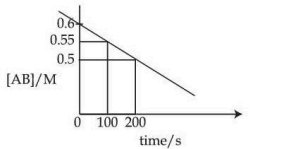
The half life of the reaction is '$x$' min.
$x = $ ___________ min. (Nearest integer)
Important Questions from Physical Chemistry
- X and Y are the number of electrons involved, respectively during the oxidation of $\text{I}^-$ to $\text{I}_2$ and $\text{S}^{2-}$ to S by acidified $\text{K}_2\text{Cr}_2\text{O}_7$. The value of X + Y is ______.
- Consider two Group IV metal ions $\text{X}^{2+}$ and $\text{Y}^{2+}$.
A solution containing 0.01 M $\text{X}^{2+}$ and 0.01 M $\text{Y}^{2+}$ is saturated with $\text{H}_2\text{S}$. The pH at which the metal sulphide YS will form as a precipitate is ______. (Nearest integer)
(Given: $\text{K}_{sp}(\text{XS}) = 1 \times 10^{-22}$ at $25^\circ\text{C}$, $\text{K}_{sp}(\text{YS}) = 4 \times 10^{-16}$ at $25^\circ\text{C}$, $[\text{H}_2\text{S}] = 0.1\text{M}$ in solution, $\text{K}_{a1} \times \text{K}_{a2}(\text{H}_2\text{S}) = 1.0 \times 10^{-21}$, $\log 2 = 0.30$, $\log 3 = 0.48$, $\log 5 = 0.70$) - Electricity is passed through an acidic solution of $\text{Cu}^{2+}$ till all the $\text{Cu}^{2+}$ was exhausted, leading to the deposition of 300 mg of Cu metal. However, a current of 600 mA was continued to pass through the same solution for another 28 minutes by keeping the total volume of the solution fixed at 200 mL. The total volume of oxygen evolved at STP during the entire process is ______ mL. (Nearest integer)
[Given:
$\text{Cu}^{2+}\text{(aq)} + 2\text{e}^- \rightarrow \text{Cu(s)} \quad \text{E}^\circ_{\text{red}} = +0.34 \text{ V}$
$\text{O}_2\text{(g)} + 4\text{H}^+ + 4\text{e}^- \rightarrow 2\text{H}_2\text{O} \quad \text{E}^\circ_{\text{red}} = +1.23 \text{ V}$
Molar mass of Cu = $63.54 \text{ g mol}^{-1}$
Molar mass of $\text{O}_2$ = $32 \text{ g mol}^{-1}$
Faraday Constant = $96500 \text{ C mol}^{-1}$
Molar volume at STP = 22.4 L] - The half-life of ${}^{65}\text{Zn}$ is 245 days. After x days, 75% of original activity remained. The value of $x$ in days is _______. (Nearest integer)
(Given: $\log 3 = 0.4771$ and $\log 2 = 0.3010$) - Molar conductivity of a weak acid HQ of concentration $0.18 \text{ M}$ was found to be $1/30$ of the molar conductivity of another weak acid HZ with concentration of $0.02 \text{ M}$. If $\lambda^\circ_{Q^-}$ happened to be equal with $\lambda^\circ_{Z^-}$, then the difference of the $\text{pK}_a$ values of the two weak acids ($\text{pK}_a\text{(HQ)} - \text{pK}_a\text{(HZ)}$) is _______ (Nearest integer).
[Given: degree of dissociation ($\alpha$) < < 1 for both weak acids, $\lambda^\circ$ : limiting molar conductivity of ions]


