
Masonry Section Cracking Eccentricity
This solution details the calculation for the minimum eccentricity that causes cracking in a masonry section, given its specific properties like zero tensile strength.
Cracking Condition Analysis
A masonry section cracks when the induced tensile stress exceeds its tensile strength. Since the tensile stress capacity is stated as zero, cracking occurs as soon as any tensile stress develops at the extreme fiber due to an eccentric load.
Stress Distribution in Rectangular Section
Consider a rectangular masonry section with width b and height h. An axial load P is applied at an eccentricity e. The stress distribution across the section follows a linear pattern.
The general stress formula is:
$ \sigma = \frac{P}{A} \pm \frac{M}{Z} $
Where:
- P = Applied axial load
- A = Cross-sectional area ($A = b \times h$)
- M = Bending moment due to eccentricity ($M = P \times e$)
- Z = Section modulus. For bending about the axis parallel to the height h, $Z = \frac{hb^2}{6}$.
The stress at the extreme fiber on the tension side is given by subtracting the bending stress from the average stress:
$ \sigma_{tension} = \frac{P}{A} - \frac{Pe}{Z} $
Substituting the area and section modulus for a rectangle:
$ \sigma_{tension} = \frac{P}{bh} - \frac{Pe}{hb^2/6} $
Simplifying this expression yields:
$ \sigma_{tension} = \frac{P}{bh} - \frac{6Pe}{hb^2} $
Minimum Eccentricity Calculation for Cracking
Cracking initiates when the tensile stress $\sigma_{tension}$ becomes zero.
Set the tensile stress formula to zero:
$ \frac{P}{bh} - \frac{6Pe}{hb^2} = 0 $
Rearranging the terms to solve for the eccentricity e:
$ \frac{P}{bh} = \frac{6Pe}{hb^2} $
Assuming $P > 0$ and $h > 0$, we can cancel terms. After simplification, we get:
$ \frac{1}{b} = \frac{6e}{b^2} $
Solving for e gives the minimum eccentricity for cracking:
$ e_{min} = \frac{b}{6} $
Result for Specified Section Width
The given width of the masonry section is b = 600 mm.
Substitute the value of b into the formula for minimum eccentricity:
$ e_{min} = \frac{600 \text{ mm}}{6} $
$ e_{min} = 100 \text{ mm} $
The question asks for the answer rounded to one decimal place.
Therefore, the minimum eccentricity at which the section will crack is 100.0 mm.
Important Questions from Design of Structural Elements
- The slenderness ratio of a circular column of diameter $300 \text{ mm}$ and effective height $3 \text{ m}$ is _________ [in integer]
- Match the structural system in Group I with their potential causes of failure in Group II
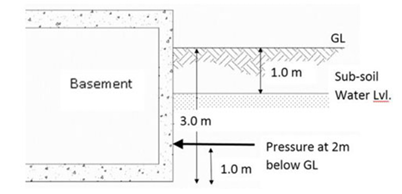
Group I Group II (P) Flat Slab (1) Thrust (Q) Long Column (2) Flutter (R) Arch (3) Punching Shear (S) Tensile Fabric (4) Buckling (5) Moment A basement wall resists lateral pressure exerted by soil and water. The soil pressure amounts to $4.5 \text{ kN/m}^2$ for every metre of depth below Ground Level (GL). The sub-soil water level is $1.0 \text{ m}$ below GL and hydrostatic pressure of water is $9.8 \text{ kN/m}^2$ for every metre of depth below GL. The total lateral pressure (in $kN/m^2$, rounded off to one decimal place) exerted on the wall $2 \text{ m}$ below GL is______
- Slenderness ratio of a column is represented as:
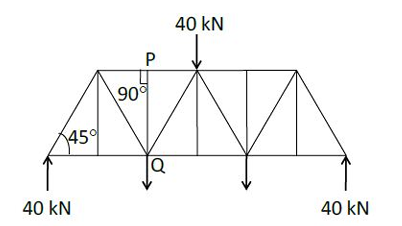
For a symmetrical two dimensional truss as shown in the above figure, vertical force in kN acting on the member PQ is ________


