
For a laminar flow of a liquid metal over a flat plate, the thicknesses of the velocity and thermal boundary layers are $\delta_v$ and $\delta_t$ respectively. Kinematic viscosity (viscosity/density) of liquid metal is significantly lower than its thermal diffusivity [thermal conductivity / (density $\times$ specific heat)]. Based on this information, pick the correct option. (Note: The temperature of the liquid metal is different from that of the plate).
Understanding Boundary Layer Thicknesses
The relative thickness between the velocity boundary layer ($\delta_v$) and the thermal boundary layer ($\delta_t$) is primarily determined by the fluid's Prandtl number ($Pr$).
Prandtl Number Definition
The Prandtl number ($Pr$) is defined as the ratio of momentum diffusivity (kinematic viscosity, $\nu$) to thermal diffusivity ($\alpha$).
$Pr = \frac{\nu}{\alpha}$
Analyzing Liquid Metal Properties
The problem states that the liquid metal has kinematic viscosity ($\nu$) significantly lower than its thermal diffusivity ($\alpha$).
- This implies $\nu \ll \alpha$.
Therefore, the Prandtl number for this liquid metal is much less than 1:
$Pr = \frac{\nu}{\alpha} \ll 1$
Relating Prandtl Number to Boundary Layers
For laminar flow over a flat plate, the ratio of thermal boundary layer thickness to velocity boundary layer thickness ($\frac{\delta_t}{\delta_v}$) is related to the Prandtl number, often approximated as $Pr^{1/3}$.
Since $Pr \ll 1$, it follows that $Pr^{1/3} \ll 1$.
$\frac{\delta_t}{\delta_v} \approx Pr^{1/3} \ll 1$
This indicates that the thermal boundary layer is significantly thinner than the velocity boundary layer.
Determining Thickness Relationship
From the relationship derived:
$\delta_t \ll \delta_v$
Thus, the correct option is $\delta_t < \delta_v$.
Important Questions from Solidification Directional Solidification
A hypothetical binary eutectic phase diagram of A – B is shown below. An alloy with 5 wt.% B solidifies with no convection. Assuming steady state, the critical temperature gradient (in K $mm^{-1}$) required to maintain planar solidification front is: ________ (round off to nearest integer).
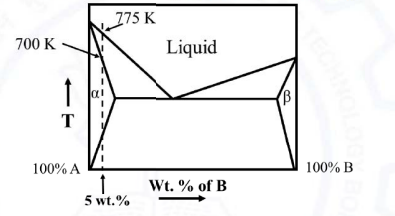
Given:
Diffusivity of B in liquid = $10^{-9}$ $m^2$ $s^{-1}$
Velocity of solidification front = 4 $\mu m$ $s^{-1}$For a solid embryo in contact with a perfectly flat mould wall as shown in the schematic, the wetting angle $\theta$ is __________ degrees.
(Round off to one decimal place).
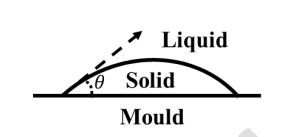
Given:
Surface tension between liquid and mould wall = $0.35 \text{ J.m}^{-2}$
Surface tension between solid and mould wall = $0.02 \text{ J.m}^{-2}$
Surface tension between liquid and solid = $0.40 \text{ J.m}^{-2}$
The constitutional undercooling condition for a hypothetical binary alloy of A with solute B during solidification is shown in the figure along with its binary phase diagram. Based on these two schematics, one can conclude that the solute concentration in region X will be _______________ the average composition of the initial liquid phase.
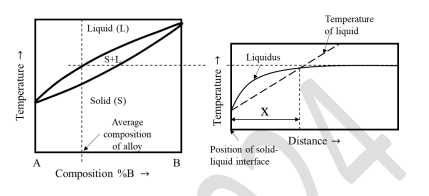
In continuous casting of steel, mould flux is used for ______________
The critical radius (in $nm$, rounded off to one decimal place) of nickel nucleus during solidification at $1673 \text{ K}$ is ________.
Given: Enthalpy of fusion of nickel = $2.65 \times 10^9 \text{ J.m}^{-3}$;
Liquid-solid interfacial energy = $0.5 \text{ J.m}^{-2}$, and
Equilibrium melting temperature of nickel = $1728 \text{ K}$.


