
A Statement is given followed by two Conclusions numbered I and II. Consider the Statement
and the Conclusions.
Statement :
India is the world's largest producer of milk.
Conclusion-I:
India is the world's largest exporter of milk.
Conclusion-II:
India does not import milk.
Which one of the following is correct?
(a) Neither Conclusion-I nor Conclusion-II follows
Understanding Statements and Conclusions in Logical Reasoning
This question asks us to analyze a statement and determine which of the given conclusions logically follow from it. This is a common type of problem in logical reasoning tests. The key is to only use the information provided in the statement and not rely on any outside knowledge, unless it's universal truth or generally accepted facts not contradicted by the statement.
Analyzing the Given Statement and Conclusions
Let's break down the statement and each conclusion:
Statement: India is the world's largest producer of milk.
This statement tells us about India's position in global milk production. It specifically mentions PRODUCER.
Conclusion-I: India is the world's largest exporter of milk.
This conclusion talks about India's position in global milk EXPORT. Does being the largest producer automatically mean being the largest exporter? Not necessarily. A country might produce a lot but consume most of it domestically due to high population or demand. Production volume doesn't directly dictate export volume. A country could produce a lot and still export very little, or even nothing.
Conclusion-II: India does not import milk.
This conclusion talks about India's milk IMPORT status. Does being the largest producer mean a country doesn't import? Not necessarily. Even the largest producer might need to import milk or specific dairy products due to various reasons like fulfilling peak domestic demand, importing specialized products not produced domestically, or cost advantages for certain types of milk. Production volume doesn't logically imply zero imports.
Evaluating if Conclusions Follow from the Statement
- Conclusion-I: The statement only mentions production. It gives no information about export volume or ranking in exports. Therefore, we cannot conclude that India is the largest exporter based solely on the statement that it is the largest producer. This conclusion does not follow.
- Conclusion-II: The statement is about production, not import. The fact that India produces the most milk globally does not logically mean it imports no milk. Domestic consumption patterns, specific product needs, and trade policies could all influence imports, regardless of high production. This conclusion does not follow.
Based on the analysis, neither Conclusion-I nor Conclusion-II logically follows from the given statement.
Determining the Correct Option
We evaluated both conclusions independently based on the provided statement. Since neither conclusion could be logically deduced from the statement:
- Conclusion-I does not follow.
- Conclusion-II does not follow.
Therefore, the correct assessment is that neither Conclusion-I nor Conclusion-II follows from the statement.
Let's look at the options provided:
- (a) Neither Conclusion-I nor Conclusion-II follows
- (b) Both Conclusion-I and Conclusion-II follow
- (c) Only Conclusion-I follows
- (d) Only Conclusion-II follows
Our analysis aligns with option (a).
Understanding the difference between production, export, and import is crucial in solving such logical reasoning questions. The statement only gives information about production, and we must stick strictly to what can be inferred from that alone.
| Element | Information from Statement | Can Conclude? | Reason |
|---|---|---|---|
| Statement | India is world's largest producer of milk. | N/A | Basis of analysis |
| Conclusion-I | India is world's largest exporter of milk. | No | Largest producer does not logically imply largest exporter. Exports depend on production relative to domestic demand and other factors. |
| Conclusion-II | India does not import milk. | No | Largest producer does not logically imply no imports. Imports depend on factors like domestic demand for specific products, trade policies, etc. |
Revision Table: Key Concepts in Statements and Conclusions
| Concept | Explanation | Example Principle |
|---|---|---|
| Statement | A given fact or set of facts to be taken as true, regardless of real-world knowledge. | "All cats are animals." (Assume this is true for the problem) |
| Conclusion | A proposition that must be logically deduced from the statement(s). | If "All cats are animals" is true, does "All animals are cats" follow? (No) |
| Logical Follows | A conclusion follows if it is impossible for the statement(s) to be true and the conclusion to be false. | If "All cats are animals" is true, "Some animals are cats" logically follows. |
| Assumption | Do not use outside knowledge unless it's a universally accepted truth not contradicted by the statement. Stick strictly to the given information. | Do not assume real-world export/import data for India unless the statement provides it. |
Additional Information: Logical Deduction
Logical deduction is the process of reasoning from one or more statements (premises) to reach a logically certain conclusion. In the context of statements and conclusions problems:
- We treat the given statement(s) as the premise(s).
- We examine the conclusions to see if they are necessarily true if the premise(s) are true.
- If a conclusion must be true whenever the statement is true, then the conclusion logically follows.
- If a conclusion could be false even if the statement is true, then the conclusion does not logically follow.
For this problem, the statement about India being the largest producer is a single premise. Neither the conclusion about exports nor the conclusion about imports can be definitively proven or disproven solely based on the production fact. Therefore, they do not logically follow.
Mastering logical deduction is key to solving various types of reasoning questions.
Important Questions from Miscellaneous Topics
- In communication the word 'Haptics' signifies :
- Which of the following statements best defines the scope of semiotics?
The compound interest on Rs. 75,000 for three years, at successive interest rates of 4%, 6% and 9% for each year respectively is:
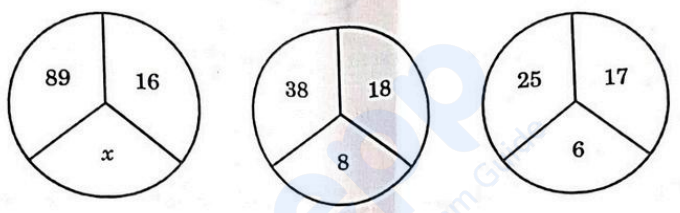
The value of x in the following figures is :
When a child reaches adolescence, there is apt to be a conflict between the parents and the child, since
the latter considers himself to be by now quite capable of managing his own affairs, while the former
are filled with parental solicitude, which is often a disguise for love of power. Parents consider, usually,
that the various moral problems which arise in adolescence are peculiarly their province. The options
they express, however, are so dogmatic that the young seldom confide in them, and usually go their
own way in secret.


