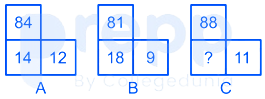
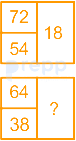
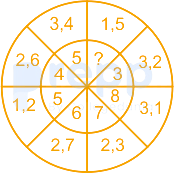
Find the missing number from the given options: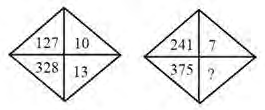
15
15 is correct.
In each diamond, the number on the right side is the sum of the digits of the number beside it on the left.
First diamond: \(1 + 2 + 7 = 10\) and \(3 + 2 + 8 = 13\).
Second diamond: \(2 + 4 + 1 = 7\), so the missing number is \(3 + 7 + 5 = 15\).
Both diamonds follow the same digit-sum rule in the upper half and in the lower half.
Similar Questions
Find the missing number from the given options:
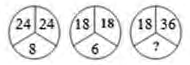
Find the missing number from the given options.
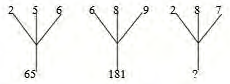
Find the missing number from the given options.
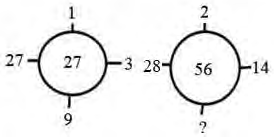
Find the missing number from the given options.
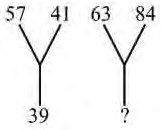
Find the missing number from the given options.
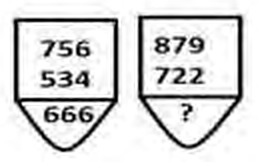
Find the missing number from the given options.
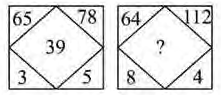
Find the missing number from the given alternatives.
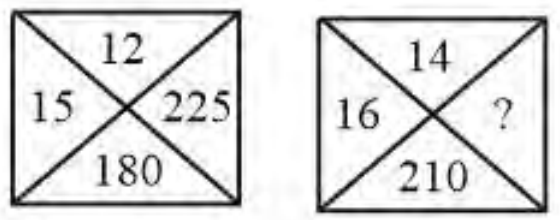
Find the missing number from the given options.
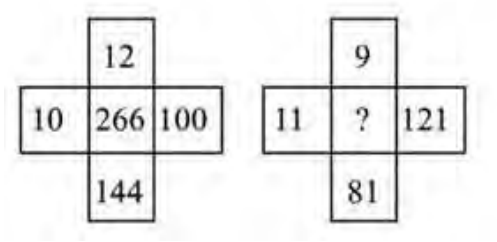
Important Questions from Missing Number in Diagram
Study the given pattern carefully and select the number that can replace the question mark (?) in it.
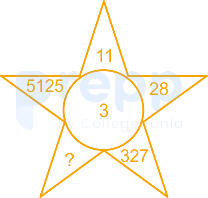
Study the given pattern carefully and select the number that can replace the question mark (?) in it:
13 108 11 26 55 9 ? 157 14 In the given square, which option will replace the question mark?
4A
6C
2E
6P
13R
7T
8N
10P
?
What is the value of the missing number?
Assuming that the numbers in each of the following figures follow a similar pattern, select the option that can replace the question mark (?) in figure C.