
Find the equivalent resistance between the points C and F for the given circuit.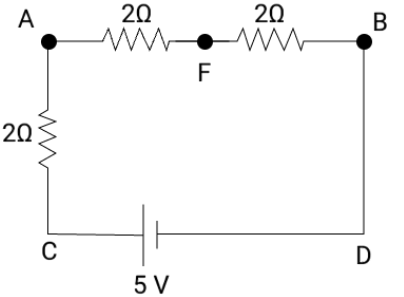
To find the equivalent resistance between points C and F in the given circuit, we can simplify the circuit step-by-step. The circuit consists of resistors connected in series and parallel combinations.
First, let's break down the components:
- The resistor between A and C is 2 Ω.
- The resistor between A and F is 2 Ω.
- The resistor between F and B is 2 Ω.
- The point D is connected to B, but does not contain a resistor connected directly to the branch of interest.
Step 1: Simplifying Series and Parallel Resistors
Between points A, C, and F, the resistors are in a configuration where:
- The resistor along CF is directly in series with the resistor along AF.
- Each path contains a 2 Ω resistor, and since they are in series, they add up directly.
Let's calculate the equivalent resistance between C and F.
The two resistors between points C and F are both 2 Ω, these resistors are in series. Hence, the equivalent resistance (Req) is calculated by:
R_{\text{eq}} = R_{\text{CF}} + R_{\text{FA}} = 2\,\Omega + 2\,\Omega = 4\,\OmegaTherefore, the equivalent resistance between points C and F is 4 Ω.
Hence, the correct answer is 4 Ω.
Important Questions from Combination of Resistors — Series and Parallel
A cell of negligible resistance and e.m.f 2 volt is connected to series combination of 2 ohm, 3 ohm and 5 ohm. The potential difference across the 3 ohm resistance is:
3 resistors of 3 ohm each connected in series. What is the mean values of resistors?
Ten cells, each of 2 volts emf and 1 ohm internal resistance are connected in series. What is the current flowing through a resistance of 10 ohms connected across this combination of cells?
Three resistor, each equal to 3 Ω are connected so as to form a triangle. The equivalent resistance between any two vertices of the triangle is:
- Two resistors R 1 and R 2 arranged in parallel combination in an electrical closed circuit are made of the same material and of the same thickness. If the length of R 2 is twice the length of R 1, then the total resistance R satisfies


