
Three resistor, each equal to 3 Ω are connected so as to form a triangle. The equivalent resistance between any two vertices of the triangle is:
2 Ω
Finding Equivalent Resistance in a Triangular Circuit
The problem asks for the equivalent resistance between any two vertices of a triangle formed by three resistors, each having a resistance of \(3 \, \Omega\). Let's label the vertices of the triangle as A, B, and C. The three resistors are connected between A and B, B and C, and C and A.
We want to find the equivalent resistance between, say, vertices A and B. When we connect a voltage source or measure resistance between A and B, current enters at A and leaves at B. The current has two paths to go from A to B:
- Directly through the resistor connected between A and B.
- Through the path from A to C, and then from C to B.
Let's analyze the path A-C-B. The resistor between A and C is \(3 \, \Omega\), and the resistor between C and B is also \(3 \, \Omega\). These two resistors are connected end-to-end, with no other path branching off from the connection point C when considering the current flow from A to B via C. Therefore, the resistors AC and CB are in series.
The equivalent resistance of resistors in series is the sum of their individual resistances. So, the equivalent resistance of the path A-C-B is:
\( R_{ACB} = R_{AC} + R_{CB} = 3 \, \Omega + 3 \, \Omega = 6 \, \Omega \)
Now, we have two effective paths between A and B:
- The direct resistor AB with a resistance of \(3 \, \Omega\).
- The series combination of AC and CB (path A-C-B) with an equivalent resistance of \(6 \, \Omega\).
These two paths are parallel to each other, as they both connect vertices A and B. To find the equivalent resistance of resistors in parallel, we use the formula:
\( \frac{1}{R_{eq}} = \frac{1}{R_1} + \frac{1}{R_2} \)
Here, \(R_1 = 3 \, \Omega\) (the direct resistor AB) and \(R_2 = 6 \, \Omega\) (the equivalent resistance of the path A-C-B).
Substituting these values into the formula:
\( \frac{1}{R_{eq}} = \frac{1}{3 \, \Omega} + \frac{1}{6 \, \Omega} \)
\( \frac{1}{R_{eq}} = \frac{2}{6 \, \Omega} + \frac{1}{6 \, \Omega} = \frac{2+1}{6 \, \Omega} = \frac{3}{6 \, \Omega} \)
\( \frac{1}{R_{eq}} = \frac{1}{2 \, \Omega} \)
Therefore, the equivalent resistance \(R_{eq}\) between vertices A and B is:
\( R_{eq} = 2 \, \Omega \)
Due to the symmetry of the triangle formed by three equal resistors, the equivalent resistance between any other pair of vertices (B and C, or C and A) will also be \(2 \, \Omega\).
Let's summarize the calculation in a step-by-step manner:
- Identify the two vertices between which the equivalent resistance is to be found (e.g., A and B).
- Identify the direct path between these two vertices (resistor AB). Its resistance is \(3 \, \Omega\).
- Identify the alternative path through the third vertex (path A-C-B). This path consists of two resistors (AC and CB) in series.
- Calculate the equivalent resistance of the series path A-C-B: \(3 \, \Omega + 3 \, \Omega = 6 \, \Omega\).
- Recognize that the direct path AB (\(3 \, \Omega\)) and the series path A-C-B (\(6 \, \Omega\)) are in parallel between vertices A and B.
- Calculate the equivalent resistance of these two parallel resistances: \( R_{eq} = \frac{3 \, \Omega \times 6 \, \Omega}{3 \, \Omega + 6 \, \Omega} = \frac{18 \, \Omega^2}{9 \, \Omega} = 2 \, \Omega \).
The equivalent resistance between any two vertices of the triangle is \(2 \, \Omega\).
This matches option 2.
Important Questions from Combination of Resistors — Series and Parallel
A cell of negligible resistance and e.m.f 2 volt is connected to series combination of 2 ohm, 3 ohm and 5 ohm. The potential difference across the 3 ohm resistance is:
3 resistors of 3 ohm each connected in series. What is the mean values of resistors?
Ten cells, each of 2 volts emf and 1 ohm internal resistance are connected in series. What is the current flowing through a resistance of 10 ohms connected across this combination of cells?
- Two resistors R 1 and R 2 arranged in parallel combination in an electrical closed circuit are made of the same material and of the same thickness. If the length of R 2 is twice the length of R 1, then the total resistance R satisfies
Consider the following part of an electric circuit:
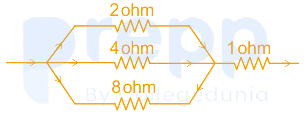
The total electrical resistance in the given part of the electric circuit is


