
Figure below shows a plot of current I through the cross-section of a wire over a time interval of 12s. How much charge flows through the wire during this time period?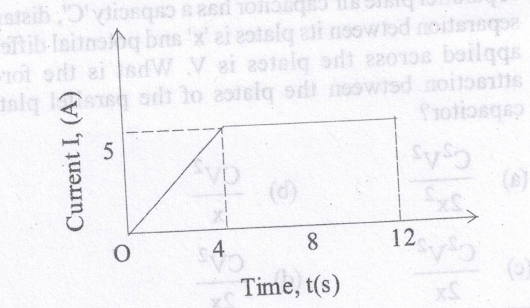
50 C
To calculate the total charge, we use the formula \( Q = I \times t \), where \( I \) is the current and \( t \) is the time. From the graph, the current increases linearly from 0 to 5 A over the first 4 seconds, so the average current during this interval is 2.5 A. For the remaining 8 seconds, the current stays constant at 5 A.
For the first 4 seconds:
\[ Q_1 = \text{Average current} \times \text{Time} = 2.5 \, \text{A} \times 4 \, \text{s} = 10 \, \text{C} \]
For the next 8 seconds:
\[ Q_2 = \text{Current} \times \text{Time} = 5 \, \text{A} \times 8 \, \text{s} = 40 \, \text{C} \]
Total charge \( Q = Q_1 + Q_2 = 10 \, \text{C} + 40 \, \text{C} = 50 \, \text{C} \)
Important Questions from Current Electricity
The current through a 4/3 Ω external resistance connected to a parallel combination of two cells of 2 V and 1 V emf and internal resistances of 1 Ω and 2 Ω respectively is:
A metallic wire of uniform area of cross-section has a resistance R, resistivity ρ, and power rating P at V volts. The wire is uniformly stretched to reduce the radius to half the original radius. The values of resistance, resistivity, and power rating at V volts are now denoted by R', ρ', and P' respectively. The corresponding values are correctly related as:
A cell of emf 1.1 V and internal resistance 0.5 Ω is connected to a wire of resistance 0.5 Ω. Another cell of the same emf is now connected in series with the intention of increasing the current, but the current in the wire remains the same. The internal resistance of the second cell is:
P, Q, R, and S are four wires of resistances 3 Ω, 3 Ω, 3 Ω, and 4 Ω, respectively. They are connected to form the four arms of a Wheatstone bridge circuit. The resistance with which S must be shunted in order that the bridge may be balanced is:
The magnetic moment of a thin bar magnet is 'M'. If it is bent into a semicircular form, its new magnetic moment will be:


