
Fed batch cultivation is suitable for which of the following? P. Processes with substrate inhibition Q. Processes with product inhibition R. High cell density cultivation
Fed Batch Cultivation Advantages
Fed batch cultivation involves adding nutrients incrementally during the fermentation process. This allows for better control over growth conditions and cell metabolism.
Suitability for Substrate Inhibition (P)
Fed batch is effective for processes with substrate inhibition. High initial substrate levels can harm cells. By feeding the substrate slowly, its concentration is kept below inhibitory levels, optimizing cell growth and productivity.
Suitability for High Cell Density (R)
This method is ideal for achieving high cell density cultivation. Controlled nutrient feeding prevents nutrient limitation and the buildup of toxic byproducts, allowing cultures to reach significantly higher cell concentrations compared to standard batch cultures.
Consideration of Product Inhibition (Q)
While fed batch can help manage product inhibition indirectly by controlling growth rates and potentially maintaining lower product concentrations, it's not the primary method specifically designed to overcome it. Other techniques might be more direct for severe product inhibition.
Conclusion
Fed batch cultivation primarily addresses challenges related to controlling substrate levels (P) and achieving high cell densities (R). These are its main areas of suitability.
Therefore, fed batch cultivation is suitable for processes with substrate inhibition (P) and high cell density cultivation (R).
Important Questions from Batch Fed Batch and Continuous Processes
- Under complete cell washout condition in a chemostat with sterile feed, which of the following statements is/are correct?
A fed batch process is running at quasi-steady state with respect to substrate and biomass concentration. At $2 \text{ h}$, the culture volume is $500 \text{ L}$ with a constant sterile inlet feed at $50 \text{ L } h^{-1}$ of glucose. The culture kinetic parameters $ \mu_m$ and $K_s$ are $0.2 \text{ } h^{-1}$ and $0.1 \text{ } g \text{ } L^{-1}$, respectively.
The substrate concentration in the reactor will be ________ $g \text{ } L^{-1}$ (rounded off to one decimal place).
The following schematic diagram shows a chemostat with cell recycle
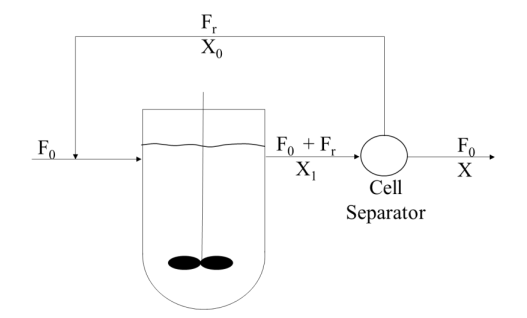
where $F_0$ and $F_r$ are the volumetric flow rates (in $L.h^{-1}$) of feed and recycle streams, respectively. $X_1$, $X_0$ and $X$ are the cell concentrations (in $g.L^{-1}$) in the reactor, recycle-stream and product-stream, respectively. If $\frac{X_0}{X_1}=1.5$, $\frac{F_r}{F_0}=0.7$ and $X_1$ is $7.3 g.L^{-1}$, the value of $X$ (in $g.L^{-1}$, rounded off to one decimal place) is ________
A $2 \text{ L}$ bioreactor is being operated as a chemostat, at a flow rate of $0.8 \text{ L/h}$ and sterile feed of $10 \text{ g/L}$ substrate. The bacterial growth follows Monod kinetics at a maximum specific growth rate of $0.6 \text{ h}^{-1}$ with a Monod constant of $0.5 \text{ g/L}$ and a biomass yield coefficient of $0.4 \text{ g/g}$. The exit biomass concentration is __________ $\text{g/L}$.
(Round off to one decimal place)
- The amount of biomass in a reactor at the end of the batch process is 50 g. Fed- batch operation is initiated by feeding the substrate solution at a constant rate of $1 \text{ L h}^{-1}$. The concentration of substrate in the feed is $50 \text{ g L}^{-1}$. The maximum biomass yield ($Y_{XS}^M$) is $0.4 \frac{\text{g biomass}}{\text{g substrate}}$. Assuming the system is at quasi-steady state, the maximum amount of biomass after 5 h of feeding is ________________ g.


