
Question
Demand for foodstuff is income inelastic. This is explained by
The correct answer is
Engel's Law
Explaining Income Inelastic Demand for Foodstuff
The question asks for the economic principle explaining why the demand for foodstuff is income inelastic. Income inelastic demand means that a change in consumer income leads to a proportionally smaller change in the quantity demanded. For necessities like food, as income rises, people spend a smaller proportion of their income on food.
Analysis of Economic Principles
Let's examine the options in relation to income elasticity of demand:
- Giffen's Paradox: Relates to the effect of price changes on demand, specifically when a good is inferior and the income effect outweighs the substitution effect, causing demand to rise with price. This is about price elasticity, not income elasticity.
- Engel's Law: This law states that as a household's income increases, the proportion of income spent on food decreases, even though the absolute amount spent on food may increase. This directly implies that the income elasticity of demand for food is positive but less than 1 ($0 < E_y < 1$), meaning it is income inelastic.
- Gossen's Law: Refers to the law of diminishing marginal utility, stating that the additional satisfaction from consuming more units of a good decreases. It doesn't directly explain the relationship between income changes and food demand proportions.
- Ricardo's Law: Typically refers to the Law of Diminishing Returns in production or theories concerning economic rent. It is unrelated to consumer demand elasticity concerning income.
Conclusion
Based on the analysis, Engel's Law is the economic principle that explains the income inelastic nature of demand for foodstuff.
Was this answer helpful?
Important Questions from Consumer behaviour
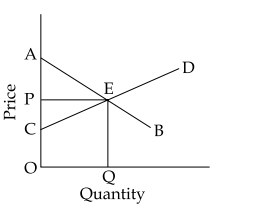
In the above diagram, the consumer surplus is represented by the area of :
- Organization responsible for preventing unfair or deceptive trade practices in textile and textile products is :
- The urge to possess and consume for display of wealth is called :
- Which of the following factors favour fashion ?
(a) Leisure
(b) An economy of abundance
(c) Transportation and communication
(d) Low income
(e) Sumptuary laws
Code : - Arrange the following Acts in the ascending order of their years of enactment :
(a) Environmental Protection Act
(b) MRTP
(c) PFA
(d) ISI Certification Marks Act
(e) Air Pollution Act
Need Expert Advice?


