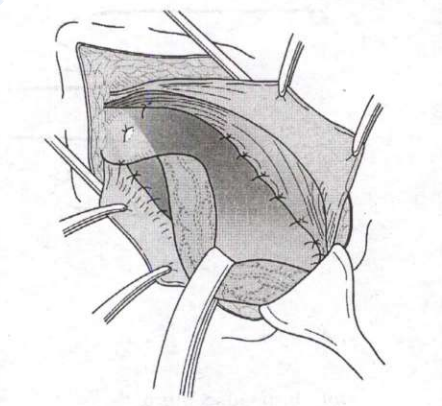
Consider the following regarding the steps in Fothergill repair surgery for uterine prolapse: 1. Plication of Mackenrodt's ligament in front of the cervix 2. Shortening of uterosacral ligaments 3. Plication of Mackenrodt's ligament behind the cervix 4. Amputation of the cervix Which of the above steps form a part of steps in Fothergill repair surgery for uterine prolapse?
1 and 4
The correct answer is 1 and 4. The Fothergill (Manchester) operation is a uterus-conserving vaginal repair for uterovaginal prolapse, classically with supravaginal elongation of the cervix. Its essential steps are amputation of the elongated cervix (statement 4) and division and plication of the Mackenrodt’s (cardinal) ligaments in front of the cervix, the stumps being sutured together anteriorly so the cervix is pulled backwards and the uterine axis corrected (statement 1, Fothergill’s stitch). The raw cervical stump is covered by the Sturmdorf suture, combined with anterior colporrhaphy and colpoperineorrhaphy.
Statement 2, shortening of the uterosacral ligaments, is not part of this operation — it belongs to the Shirodkar sling, McCall culdoplasty and high uterosacral suspension. Statement 3, plicating Mackenrodt’s ligament behind the cervix, is the wrong direction: posterior plication would push the cervix forward and worsen the prolapse. With 2 and 3 both false, only 1 and 4 survive.
Key point: Manchester repair equals cervical amputation plus anterior cardinal ligament plication plus Sturmdorf suture; it risks cervical stenosis, incompetence and mid-trimester abortion, so avoid it in women wanting children.
Important Questions from Displacement of Uterus
- Which of the following symptoms can be associated with pelvic organ prolapse?
1. Difficulty in passing urine
2. Incomplete evacuation of urine
3. Urgency and frequency
Select the correct answer using the code given below: Which of the following is NOT an ideally suited condition for use of ring pessary in case of uterine prolapse?
- Procidentia as a degree of uterovaginal prolapse is characterised by descent of
- In POPQ classification for uterovaginal prolapse, the only measurement done after reducing the prolapse is
Which of the following are essential steps of Fothergill's operation?
1. Laparoscopic or vaginal ligation
2. Amputation of cervix
3. Plication of Mackenrodt's ligaments in front of cervix
4. Ant colporrhaphy
Select the correct answer using the code given below.