
Consider following statements for refraction of light through prism, when angle of deviation is minimum. A. The refracted ray inside prism becomes parallel to the base. B. Larger angle prisms provide smaller angle of minimum deviation. C. Angle of incidence and angle of emergence becomes equal. D. There are always two sets of angle of incidence for which deviation will be same except at minimum deviation setting. E. Angle of refraction becomes double of prism angle. Choose the correct answer from the options given below:
A, C and D Only
Analysis of Prism Refraction at Minimum Deviation
The question asks about the conditions for the minimum angle of deviation ($\delta_m$) when light passes through a prism.
Statement Analysis:
- Statement A: The refracted ray inside prism becomes parallel to the base.
At minimum deviation, the light ray travels symmetrically through the prism. This means the angle of incidence equals the angle of emergence ($i = e$), and the angles of refraction are equal ($r_1 = r_2$). Since $r_1 + r_2 = A$ (prism angle), we have $r_1 = r_2 = A/2$. When $r_1 = r_2$, the refracted ray inside the prism is parallel to the base. Thus, Statement A is True. - Statement B: Larger angle prisms provide smaller angle of minimum deviation.
The relation between prism angle ($A$), minimum deviation ($\delta_m$), and refractive index ($n$) is given by $\sin\left(\frac{A+\delta_m}{2}\right) = n \sin\left(\frac{A}{2}\right)$. For small angles, this approximates to $\delta_m \approx (n-1)A$. This implies that for a given refractive index $n$, a larger prism angle $A$ results in a larger minimum deviation angle $\delta_m$. Thus, Statement B is False. - Statement C: Angle of incidence and angle of emergence becomes equal.
Symmetry is the key characteristic of minimum deviation. This symmetry implies that the angle of incidence ($i$) must be equal to the angle of emergence ($e$). Thus, Statement C is True. - Statement D: There are always two sets of angle of incidence for which deviation will be same except at minimum deviation setting.
For any angle of deviation $\delta$ that is greater than $\delta_m$ (but less than the maximum possible deviation), there are two possible angles of incidence that will produce that specific deviation. Only at $\delta_m$ is there a unique angle of incidence. Thus, Statement D is True. - Statement E: Angle of refraction becomes double of prism angle.
As established in the analysis of Statement A, at minimum deviation, the angles of refraction inside the prism are $r_1 = r_2 = A/2$. This is half the prism angle, not double. Thus, Statement E is False.
Conclusion:
Based on the analysis, the correct statements are A, C, and D.
Similar Questions
The radii of curvature for a thin convex lens are $10 \ cm$ and $15 \ cm$ respectively. The focal length of the lens is $12 \ cm$. The refractive index of the lens material is
The work function of a metal is $3 \ eV$. The color of the visible light that is required to cause emission of photoelectrons is
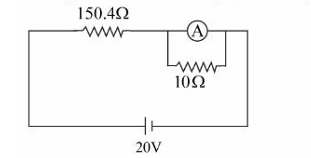
In the figure shown below, a resistance of $150.4 \Omega$ is connected in series to an ammeter A of resistance $240 \Omega$. A shunt resistance of $10 \Omega$ is connected in parallel with the ammeter. The reading of the ammeter is __________ mA.
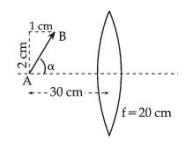
A slanted object AB is placed on one side of convex lens as shown in the diagram. The image is formed on the opposite side. Angle made by the image with principal axis is :
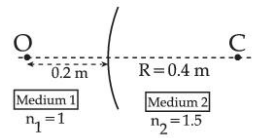
A spherical surface separates two media of refractive indices 1 and 1.5 as shown in figure. Distance of the image of an object 'O', is :
(C is the center of curvature of the spherical surface and R is the radius of curvature)- If the measured angular separation between the second minimum to the left of the central maximum and the third minimum to the right of the central maximum is $30^\circ$ in a single slit diffraction pattern recorded using 628 nm light, then the width of the slit is _________ $\mu$m.
- A finite size object is placed normal to the principal axis at a distance of 30 cm from a convex mirror of focal length 30 cm. A plane mirror is now placed in such a way that the image produced by both the mirrors coincide with each other. The distance between the two mirrors is:
- Two polarisers $P_1$ and $P_2$ are placed in such a way that the intensity of the transmitted light will be zero. A third polariser $P_3$ is inserted in between $P_1$ and $P_2$, at particular angle between $P_2$ and $P_3$. The transmitted intensity of the light passing the through all three polarisers is maximum. The angle between the polarisers $P_2$ and $P_3$ is :
- In a Young's double slit experiment, two slits are located 1.5 mm apart. The distance of screen from slits is 2 m and the wavelength of the source is 400 nm. If the 20 maxima of the double slit pattern are contained within the central maximum of the single slit diffraction pattern, then the width of each slit is $x\times10^{-3}$ cm, where x-value is ________.
- Two thin convex lenses of focal lengths $30 \text{ cm}$ and $10 \text{ cm}$ are placed coaxially, $10 \text{ cm}$ apart. Thepower of this combination is:
Important Questions from Optics
The radii of curvature for a thin convex lens are $10 \ cm$ and $15 \ cm$ respectively. The focal length of the lens is $12 \ cm$. The refractive index of the lens material is
The work function of a metal is $3 \ eV$. The color of the visible light that is required to cause emission of photoelectrons is
In the figure shown below, a resistance of $150.4 \Omega$ is connected in series to an ammeter A of resistance $240 \Omega$. A shunt resistance of $10 \Omega$ is connected in parallel with the ammeter. The reading of the ammeter is __________ mA.
A slanted object AB is placed on one side of convex lens as shown in the diagram. The image is formed on the opposite side. Angle made by the image with principal axis is :
A spherical surface separates two media of refractive indices 1 and 1.5 as shown in figure. Distance of the image of an object 'O', is :
(C is the center of curvature of the spherical surface and R is the radius of curvature)


