Consider a spherical globe rotating about an axis passing through its poles. There are three points P, Q, and R situated respectively on the equator, the north pole, and midway between the equator and the north pole in the northern hemisphere. Let P, Q, and R move with speeds $v_P$, $v_Q$, and $v_R$, respectively. Which one of the following options is CORRECT?
Analyzing Rotational Speeds on a Globe
The linear speed ($v$) of a point on a rotating object is given by the formula: $v = \omega r$ where $\omega$ is the angular velocity (same for all points on the rigid body) and $r$ is the perpendicular distance of the point from the axis of rotation.
Determining Distances from Rotation Axis
The globe rotates about an axis passing through its poles. Let the radius of the globe be $R$. The axis of rotation is the line connecting the North Pole (Q) and the South Pole.
- Point P (Equator): Located on the equator, its distance from the axis of rotation is equal to the radius of the globe. So, $r_P = R$.
- Point Q (North Pole): Located at the North Pole, it lies on the axis of rotation. Thus, its distance from the axis is zero. So, $r_Q = 0$.
- Point R (Midway): Located midway between the equator and the North Pole, it is at a latitude of $45^\circ$. The perpendicular distance from the axis of rotation for a point at latitude $\lambda$ is $R \cos(\lambda)$. Therefore, $r_R = R \cos(45^\circ) = R \frac{\sqrt{2}}{2}$.
Calculating and Comparing Speeds
Using the formula $v = \omega r$:
- Speed of P: $v_P = \omega r_P = \omega R$
- Speed of Q: $v_Q = \omega r_Q = \omega \times 0 = 0$
- Speed of R: $v_R = \omega r_R = \omega \left( R \frac{\sqrt{2}}{2} \right)$
Since $\frac{\sqrt{2}}{2} \approx 0.707$, we have $v_R \approx 0.707 \omega R$. As $\omega$ and $R$ are positive constants:
- $v_P = \omega R$
- $v_R = \frac{\sqrt{2}}{2} \omega R$
- $v_Q = 0$
Comparing these values, we find that $v_P > v_R > v_Q$.
Thus, the correct relationship is $v_P > v_R > v_Q$.
Important Questions from Numerical Reasoning
- Let $p_1$ and $p_2$ denote two arbitrary prime numbers. Which one of the following statements is correct for all values of $p_1$ and $p_2$?
- A 'frabjous' number is defined as a 3 digit number with all digits odd, and no two adjacent digits being the same. For example, 137 is a frabjous number, while 133 is not. How many such frabjous numbers exist?
Ankita has to climb 5 stairs starting at the ground, while respecting the following rules:
1. At any stage, Ankita can move either one or two stairs up.
2. At any stage, Ankita cannot move to a lower step.
Let $F(N)$ denote the number of possible ways in which Ankita can reach the $N^{th}$ stair. For example, $F(1) = 1$, $F(2) = 2$, $F(3) = 3$. The value of $F(5)$ is ________.- In a zoo, three lions and four tigers eat 390 kg of food every week. In another zoo, four lions and five tigers eat 500 kg of food every week. Lions and tigers eat different amounts of food, but all individuals of the same species eat the same amount. The amount of food a single lion eats per week is ________ kg.
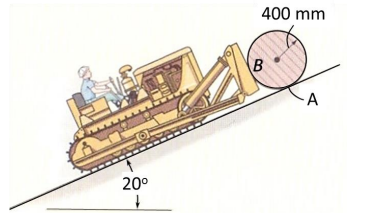
(Answer in integer) A dozer pushes up a 100 kg spool of cable along a $20^ \circ$ incline road at a constant velocity as shown in the figure. The figure shows a dozer pushing a spool (diameter 400 mm) up a $20^ \circ$ incline. Point A is the contact point between the spool and the road, and Point B is the contact point between the dozer bucket and the spool. The coefficient of static friction between the dozer bucket and the spool (Point B) is 0.45, and coefficient of kinetic friction between road and the spool (Point A) is 0.15.
Consider the spool only slides up the incline. The maximum normal force in N acting at Point B, is ___________ [rounded off to 1 decimal place]