
Circles $C_1$, $C_2$, and $C_3$, with centers $O_1$, $O_2$, and $O_3$ , and radii $r_1$ , $r_2$, and $r_3$, respectively, touch each other as shown in the following figure. Given $r_1 = 2\text{ cm}$, $r_2 = 1\text{ cm}$ and the angle $\angle O_1O_3O_2$ is $90^\circ$, $r_3 =$ _____ cm.
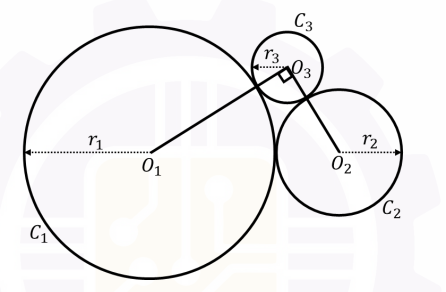
To find the radius \( r_3 \) of the circle \( C_3 \), we need to use the geometry of the given figure, including the fact that \(\angle O_1O_3O_2 = 90^\circ\).
Given: \(r_1 = 2 \text{ cm}\), \(r_2 = 1 \text{ cm}\), \(\angle O_1O_3O_2 = 90^\circ\).
Using the Pythagorean theorem in \(\triangle O_1O_3O_2\):
\(O_1O_2 = O_1O_3 + O_3O_2\\)
The distance between centers \(O_1\) and \(O_2\) is the sum of the radii of the tangent circles:
\(O_1O_2 = r_1 + r_2 = 2 + 1 = 3 \text{ cm}\)
By the geometry of the circle: \(O_1O_3 = r_1 - r_3\\) and \(O_2O_3 = r_2 - r_3\\)
Substituting into the Pythagorean theorem:
\((r_1 - r_3)^2 + (r_2 - r_3)^2 = (r_1 + r_2)^2\)
\( (2 - r_3)^2 + (1 - r_3)^2 = 3^2 \)
Expanding:
\( (4 - 4r_3 + r_3^2) + (1 - 2r_3 + r_3^2) = 9 \)
Combine like terms: \(2r_3^2 - 6r_3 + 5 = 9\)
Simplify: \(2r_3^2 - 6r_3 - 4 = 0\)
Divide throughout by 2: \(r_3^2 - 3r_3 - 2 = 0\)
Solve using the quadratic formula, \(r_3 = \frac{-b \pm \sqrt{b^2 - 4ac}}{2a}\), where \(a = 1\), \(b = -3\), \(c = -2\).
Calculate the discriminant: \(\sqrt{(-3)^2 - 4 \cdot 1 \cdot (-2)} = \sqrt{9 + 8} = \sqrt{17}\)
Therefore, \(r_3 = \frac{3 \pm \sqrt{17}}{2}\)
Selecting the positive value (as the radius cannot be negative), \(r_3 = \frac{3 + \sqrt{17}}{2}\)
The correct answer is: \(\frac{1}{2}(-3 + \sqrt{17} )\)
Important Questions from Mensuration and Geometry
The city of Atlantis was crafted by the God of the seas, Poseidon. It was made of alternating concentric circular rings of land (shaded) and water (not shaded) as represented in the figure (not to scale). The radius of Inner Island was 2.5 stades (a unit of length used in ancient Greece). The water surrounding Inner Island was one stade wide (length AB). This was surrounded by two pairs of alternating rings of land and water. The first pair of land and water was two stades wide each (lengths BC and CD), and the outer pair is three stades wide each (lengths DE and EF).
The ratio of the surface area of the land to that of the water in the city of Atlantis is _________ (round off to two decimal places).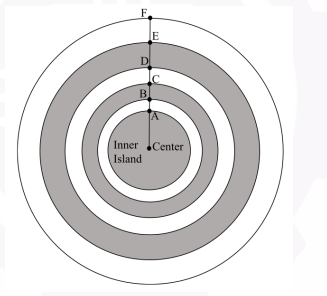
In the given figure, $P, Q$, and $R$ are three points on a circle of radius 10 cm with $O$ as its center, $\overline{PQ} = \overline{RQ}$, and $\angle PQR = 45^\circ$. The figure is representative.
The area of the shaded region $PQRO$ is ______________ cm$^2$.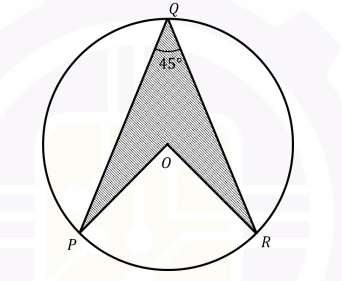
- A straight line $y = x - 1$ intersects a circle with center at $x = 1, y = 1$ and radius of magnitude 1 at two points. The length of the chord formed by this intersection is _______. (rounded off to three decimal places)
- The shell of a hollow spherical nanoparticle has a uniform thickness of 3 nanometers (nm). The outer radius of the nanoparticle is 5 nm. The ratio of the volume of the shell to the volume of the hollow core is ________
(Round off to one decimal place) - The volume of a sphere of diameter 1 unit is ______ than the volume of a cube of side 1 unit.


