
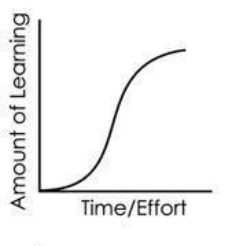
Learning Curve Representations
A learning curve visually represents how learning or skill improves with experience. Typically, experience is plotted on the horizontal axis (X-axis) and performance or proficiency is plotted on the vertical axis (Y-axis). It helps visualize the efficiency and speed of learning.
Positive Accelerated Curve Identification
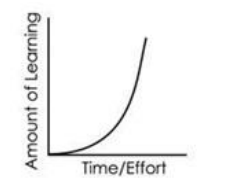
The question asks to identify a positive accelerated learning curve. This specific type of curve shows that the rate of learning is *increasing* over time. Initially, progress might be slow, but as more experience is gained, the speed at which performance improves gets faster and faster. Graphically, this means the slope of the curve becomes progressively steeper.
Let's examine each chart provided in the options to see which one fits this description:
Negative Acceleration Chart (Option 1)
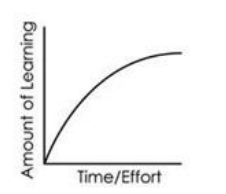
This chart displays a curve where performance improves rapidly at the beginning. However, the rate of improvement gradually decreases as experience increases, causing the curve to flatten out. This represents negative acceleration, not positive acceleration.
Linear Learning Chart (Option 2)
This chart shows performance improving at a steady, constant rate relative to experience. The slope of the curve is constant, indicating linear learning. This is neither positive nor negative acceleration.
Positive Acceleration Chart (Option 3)
In this chart, performance starts low and improves slowly initially. As experience accumulates, the rate of performance improvement increases significantly. The curve becomes noticeably steeper over time. This pattern perfectly matches the definition of a positive accelerated learning curve.
Negative Acceleration Chart (Option 4)
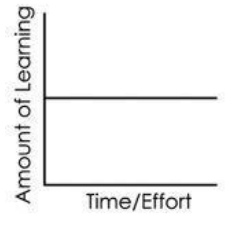
Similar to Option 1, this chart shows performance increasing, but the rate of increase slows down over time. The curve gets flatter, indicating diminishing returns in the rate of learning, which is characteristic of negative acceleration.
Conclusion: Positive Curve
By analyzing the shape and slope changes in each chart, we can conclude that the chart in Option 3 is the correct representation of a positive accelerated learning curve, where the learning process speeds up as experience grows.
Important Questions from Job Description & Job Specification - Teaching
- In an organization, what outlines the requirements, qualifications, and competencies needed for a particular job role?
- Statement I: Systems concepts are said to be abstract and vague.
Statement II: Too many sub-systems and interdependence among them make the task of manager very easy.
In the light of the above two statements choose the appropriate answer from the options given below: - Match List - I and List - II.
List - 1 List - II (A) F.W. Taylor (I) Business Management as a profession (B) Henry Fayol (II) Father of Scientific Management (C) Mary Parker Follett (III) Father of Human Relations Movement (D) George Elton Mayo (IV) Administrative Management Theory
Choose the correct answer from the options given below: - No management theory and technique is appropriate in all situations'. This is a basic idea of __________ approach.
- Managers must analyse different situations and use the best approach which is most suitable for that situation. This concept is __________.


