
Question
Define f(t)=sin t/t for t≠0 and f(0)=1 by continuous extension. At t=0,f has:
The correct answer is
a maximum
With f(0)=1, Taylor expansion gives f(t)=1−t²/6+O(t⁴). Thus f′(0)=0 and f″(0)=−1/3<0. It has a maximum at zero. Without the extension, sin t/t is undefined there.
Was this answer helpful?
Important Questions from Calculus
Given $y = x^2+x+6$, the value of $\frac{d}{dx}(\ln y)$ at $x=2$ is ________________.
The slope of the function \( y = x - x^{2} \) at \( x = 1 \) is ____________
Water flows over a plate of finite length. At $x = x_1$ from the leading edge, the velocity of the flow is $V_x = 0.5y - 0.5y^3$. The thickness, $\delta$ (in meter) of the boundary layer at $x = x_1$ is: _________ (round off to 2 decimal places).
Given: $V_\infty$ is the free stream velocity.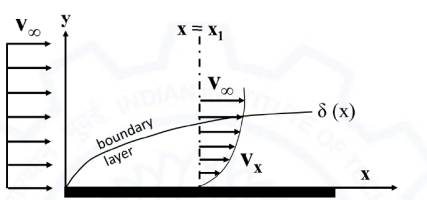
- The power series expansion of a function is given as
$\frac{1}{x}\ln(1 + x) = 1 + bx + cx^2 + \dots$
for $0 < x \le 1$.
The values of constants $b$ and $c$, respectively, are - Given, $z (x, y) = e^{x-2y}$, where $x(t) = e^t$ and $y(t) = e^{-t}$. All the variables are real. The total differential $\frac{dz}{dt}$ is
Need Expert Advice?


