
Assertion 'a': During casting of aluminium, grain refinement can be achieved by addition of certain alloying elements. Reason 'r' : The addition of the alloying element may result in the formation of deoxidation products or intermetallic compounds which may act as nucleation sites for grain refinement.
Aluminium Casting Grain Refinement: Assertion and Reason
Assertion Analysis
The assertion states that grain refinement in aluminium casting can be achieved by adding specific alloying elements. This statement is true. Adding elements like Titanium (Ti) and Boron (B) is a common industrial practice to refine the grain structure of aluminium alloys, leading to improved mechanical properties.
Reason Analysis
The reason explains the mechanism behind grain refinement, attributing it to the formation of deoxidation products or intermetallic compounds from the added alloying elements. These compounds act as heterogeneous nucleation sites. This statement is also true. These finely dispersed particles provide surfaces upon which new aluminium grains can nucleate and grow during solidification, promoting a finer grain structure.
Relationship Between Assertion and Reason
The mechanism described in the reason (formation of nucleation sites by alloying elements) directly explains *how* the assertion (grain refinement via alloying elements) is achieved. Therefore, the reason is a valid explanation for the assertion.
Conclusion
Both the assertion and the reason are true, and the reason correctly explains the assertion.
This corresponds to Option 2: Both 'a' and 'r' are true and 'r' is the reason for 'a'.
Important Questions from Solidification Directional Solidification
A hypothetical binary eutectic phase diagram of A – B is shown below. An alloy with 5 wt.% B solidifies with no convection. Assuming steady state, the critical temperature gradient (in K $mm^{-1}$) required to maintain planar solidification front is: ________ (round off to nearest integer).
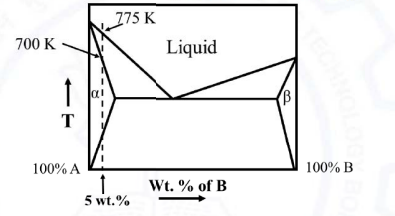
Given:
Diffusivity of B in liquid = $10^{-9}$ $m^2$ $s^{-1}$
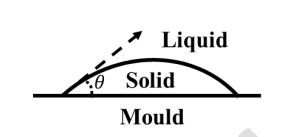
Velocity of solidification front = 4 $\mu m$ $s^{-1}$For a solid embryo in contact with a perfectly flat mould wall as shown in the schematic, the wetting angle $\theta$ is __________ degrees.
(Round off to one decimal place).
Given:
Surface tension between liquid and mould wall = $0.35 \text{ J.m}^{-2}$
Surface tension between solid and mould wall = $0.02 \text{ J.m}^{-2}$
Surface tension between liquid and solid = $0.40 \text{ J.m}^{-2}$
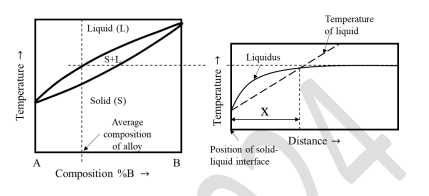
The constitutional undercooling condition for a hypothetical binary alloy of A with solute B during solidification is shown in the figure along with its binary phase diagram. Based on these two schematics, one can conclude that the solute concentration in region X will be _______________ the average composition of the initial liquid phase.
In continuous casting of steel, mould flux is used for ______________
The critical radius (in $nm$, rounded off to one decimal place) of nickel nucleus during solidification at $1673 \text{ K}$ is ________.
Given: Enthalpy of fusion of nickel = $2.65 \times 10^9 \text{ J.m}^{-3}$;
Liquid-solid interfacial energy = $0.5 \text{ J.m}^{-2}$, and
Equilibrium melting temperature of nickel = $1728 \text{ K}$.


