
Arrange the following DNA fragments A, B, C, D separated after Gel Electrophoresis in increasing order of number of their base pairs
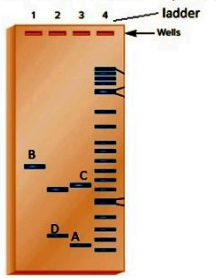
To determine the increasing order of DNA fragments (A, B, C, D) based on the number of base pairs, we need to understand how gel electrophoresis works. In gel electrophoresis, DNA fragments are separated by size, with smaller fragments moving faster and thus further through the gel than larger ones.
In the provided image, the position of the fragments relative to the wells and the ladder gives us information about their size:
- Fragment A is closest to the bottom, indicating it has the smallest number of base pairs.
- Fragment D is above A, suggesting it has more base pairs than A but fewer than C and B.
- Fragment C is above D, indicating it has more base pairs than D.
- Fragment B is the closest to the wells, meaning it has the largest number of base pairs.
By examining their positions, we can arrange the fragments in increasing order of their size:
- A - Smallest number of base pairs
- D - Greater than A
- C - Greater than D
- B - Largest number of base pairs
Thus, the correct order of fragments from smallest to greatest number of base pairs is A, D, C, B.
Important Questions from Botany (CUET PG) Mixed
- Who coined the word 'ecology'.
- Match List-I with List-II
List-1
(Name of Interaction)List-II
(Species A, Species B)(A). Mutualism (I). +, - (B). Commensalism (II). +, + (C). Competition (III). +, 0 (D). Predation (IV). -, -
Choose the correct answer from the options given below: - What is the sequence of the template DNA for an mRNA with the sequence?
5'-CAUUGGCCAAGG-3' - Which type of polymerase activity is shown by the enzyme telomerase?
- If the growth medium of a bacterial strain contains both glucose and lactose, how does it affect
the lac operon?
A. CAP protein binds lac promoter
B. Repressor binds lac operator
C. CAP protein does not bind lac promoter
D. Repressor does not bind lac operator
Choose the most appropriate answer from the options given below:


