
An organization is granted the block 130.56.0.0/16. The administrator wants to create 1024 subnets. Find first and last addresses of First subnet. 1. 130.56.0.0 130.56.254.254 2. 130.56.0.0 130.56.0.63 3. 130.0.0.0 130.255.255.255 4. 130.56.0.0 130.56.255.63
2
Subnetting an IPv4 Block: Finding the First Subnet Addresses
Let's break down how to find the first and last addresses of the first subnet when an organization is granted the block 130.56.0.0/16 and wants to create 1024 subnets. This involves understanding subnetting concepts like network address, subnet mask, borrowed bits, and block size.
Understanding the Original Network Block 130.56.0.0/16
The given network block is 130.56.0.0/16.
- The address 130.56.0.0 is in the Class B range (128.0.0.0 to 191.255.255.255).
- The /16 (CIDR notation) means the first 16 bits of the IP address are used for the network portion.
- In IPv4, there are 32 bits in total. With 16 bits for the network, the remaining bits are for host addresses.
- Total bits for host addresses = 32 - 16 = 16 bits.
- The default subnet mask for a /16 network is 255.255.0.0.
Calculating Subnet Bits for 1024 Subnets
The administrator wants to create 1024 subnets from the 130.56.0.0/16 block. To find the number of bits needed for subnetting, we use the formula:
Number of subnets = $2^n$
Where 'n' is the number of bits borrowed from the host portion to create subnets. We are given that the number of subnets is 1024.
$2^n = 1024$
To find 'n', we calculate the base-2 logarithm of 1024:
$n = \log_2(1024)$
Since $2^{10} = 1024$, we find that $n = 10$.
This means we need to borrow 10 bits from the original 16 host bits to create 1024 subnets.
Determining the New Subnet Mask
The original network mask was /16. We borrowed 10 bits for subnetting.
- New subnet mask length = Original network bits + Borrowed bits
- New subnet mask length = 16 + 10 = 26 bits.
The new subnet mask is /26. Let's represent this in binary and dotted decimal:
- Original mask (/16): 11111111.11111111.00000000.00000000 (255.255.0.0)
- New mask (/26): 11111111.11111111.11111111.11000000
Converting the new binary mask to dotted decimal:
- First octet: 11111111 = 255
- Second octet: 11111111 = 255
- Third octet: 11111111 = 255
- Fourth octet: 11000000 = 128 + 64 = 192
The new subnet mask is 255.255.255.192. This is a /26 mask.
Calculating Subnet Block Size
After borrowing 10 bits for subnetting, the remaining bits in the 32-bit IP address are for host addresses within each subnet.
- Total bits = 32
- Network/Subnet bits = 26
- Host bits = 32 - 26 = 6 bits.
The number of addresses in each subnet (the block size) is determined by the number of host bits:
Block size = $2^{\text{number of host bits}}$
Block size = $2^6 = 64$.
This means each subnet will contain 64 IP addresses. The network addresses of successive subnets will increment by 64. Since the host bits are in the fourth octet (the mask is /26, extending into the fourth octet), the increment of 64 applies to the fourth octet.
Finding Addresses for the First Subnet
The first subnet always starts with the original network address.
- First subnet network address: 130.56.0.0
The addresses within the first subnet range from the network address up to the broadcast address. The next subnet will start at the first network address plus the block size.
- First subnet network address: 130.56.0.0
- Next subnet network address: 130.56.0.0 + 64 (in the fourth octet) = 130.56.0.64
The broadcast address of a subnet is the IP address immediately before the network address of the next subnet.
- First subnet broadcast address (last address): 130.56.0.64 - 1 = 130.56.0.63
So, the addresses in the first subnet range from 130.56.0.0 to 130.56.0.63.
- First address of the first subnet (Network Address): 130.56.0.0
- Last address of the first subnet (Broadcast Address): 130.56.0.63
Within this subnet (130.56.0.0/26), the usable IP addresses for hosts would be from 130.56.0.1 to 130.56.0.62 (excluding the network and broadcast addresses).
Comparing with Options
Let's compare our calculated first and last addresses for the first subnet with the given options:
- Option 1: 130.56.0.0, 130.56.254.254 (Incorrect - last address is too high)
- Option 2: 130.56.0.0, 130.56.0.63 (Correct - matches our calculated range)
- Option 3: 130.0.0.0, 130.255.255.255 (Incorrect - this represents the entire Class B network range, not a subnet)
- Option 4: 130.56.0.0, 130.56.255.63 (Incorrect - last address is too high and does not align with a /26 mask)
Our calculation confirms that Option 2 provides the correct first and last addresses for the first subnet derived from subnetting 130.56.0.0/16 into 1024 subnets.
Revision Table: Key Subnetting Terms
| Term | Description |
|---|---|
| Network Address | The first address in a network or subnet, used to identify the network itself. All host bits are 0. |
| Broadcast Address | The last address in a network or subnet, used to send data to all devices in that network/subnet. All host bits are 1. |
| Subnet Mask | A 32-bit number that separates the network/subnet portion from the host portion of an IP address. |
| CIDR (/ notation) | Classless Inter-Domain Routing notation, indicating the number of network bits in the IP address. |
| Host Address Range | The range of usable IP addresses for devices within a network or subnet (excluding the network and broadcast addresses). |
Additional Information: Subnetting and IP Addressing
Subnetting is the process of dividing a large network into smaller, more manageable sub-networks. This is done by borrowing bits from the host portion of the IP address and adding them to the network portion. Subnetting helps in improving network performance, security, and organization, as well as conserving IP addresses.
The original block 130.56.0.0/16 is a standard Class B network address range under older classful addressing rules. However, modern networks primarily use CIDR (Classless Inter-Domain Routing), which allows for more flexible network prefixes (like /26 in our case) regardless of the IP address class. This provides much more flexibility in network design and IP address allocation. The technique used here, calculating borrowed bits and block size, is fundamental to both classful subnetting and classless addressing.
Important Questions from IPv4
An organization is granted the block 130.56.0.0/16. The administrator wants to create 1024 subnets. Find first and last addresses of last subnet.
1.
130.56.0.0
130.56.254.255
2.
130.56.255.0
130.56.255.255
3.
130.56.0.192
130.255.255.255
4.
130.56.255.192
130.56.255.255
An organization is granted the block 130.56.0.0/16. The administrator wants to create 1024 subnets. Find the subnet prefix.
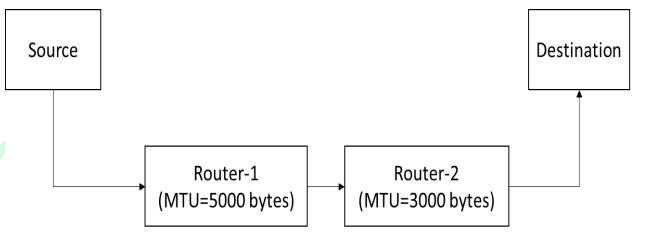
Suppose a message of size 15000 bytes is transmitted from a source to a destination using IPv4 protocol via two routers as shown in the figure. Each router has a defined maximum transmission unit (MTU) as shown in the figure, including IP header. The number of fragments that will be delivered to the destination is ________ . (Answer in integer)
- A machine receives an IPv4 datagram. The protocol field of the IPv4 header has the protocol number of a protocol X.
Which ONE of the following is NOT a possible candidate for X? - Consider a network that uses Ethernet and IPv4. Assume that IPv4 headers do not use any options field. Each Ethernet frame can carry a maximum of 1500 bytes in its data field. A UDP segment is transmitted. The payload (data) in the UDP segment is 7488 bytes.
Which ONE of the following choices has the CORRECT total number of fragments transmitted and the size of the last fragment including IPv4 header?


