
Understanding Electric Field Interaction in Hydrogen Atom
When an electric field $\vec{E} = E_0 \hat{z}$ is applied to a Hydrogen atom, the interaction Hamiltonian $H'$ is given by the potential energy of the electron in this field. For an electron with charge $-e$, this is:
$H' = -e \vec{r} \cdot \vec{E}$
Substituting $\vec{E} = E_0 \hat{z}$, we get:
$H' = -e (x\hat{x} + y\hat{y} + z\hat{z}) \cdot (E_0 \hat{z})$
$H' = -e E_0 z$
This interaction Hamiltonian involves the operator $z$. We need to find the matrix element $\langle \psi_{initial} | H' | \psi_{final} \rangle$ that is non-zero.
Quantum Mechanical Selection Rules
For electric dipole transitions induced by an operator proportional to $z$, specific quantum mechanical selection rules must be met:
- The change in the orbital angular momentum quantum number, $\Delta l$, must be $\pm 1$. ($l_f - l_i = \pm 1$)
- The change in the magnetic quantum number, $\Delta m$, must be $0$. ($m_f - m_i = 0$)
The problem specifies the $n=2$ state, which is fourfold degenerate. The given basis states $|l,m\rangle$ refer to these $n=2$ states. The initial state is $|0,0\rangle$, which corresponds to $l_i = 0$ and $m_i = 0$. The potential final states are $|1,1\rangle, |1,0\rangle, |1,-1\rangle$, all corresponding to $l_f = 1$.
Analyzing Matrix Element Options
We examine each option using the selection rules $\Delta l = \pm 1$ and $\Delta m = 0$:
-
Option 1: $\langle 0,0|H'|0,0 \rangle$
Initial state: $l_i=0, m_i=0$. Final state: $l_f=0, m_f=0$. $\Delta l = l_f - l_i = 0 - 0 = 0$. This violates the $\Delta l = \pm 1$ rule. Thus, the matrix element is zero.
-
Option 2: $\langle 0,0|H'|1,1 \rangle$
Initial state: $l_i=0, m_i=0$. Final state: $l_f=1, m_f=1$. $\Delta l = l_f - l_i = 1 - 0 = 1$. This satisfies $\Delta l = \pm 1$. $\Delta m = m_f - m_i = 1 - 0 = 1$. This violates the $\Delta m = 0$ rule. Thus, the matrix element is zero.
-
Option 3: $\langle 0,0|H'|1,0 \rangle$
Initial state: $l_i=0, m_i=0$. Final state: $l_f=1, m_f=0$. $\Delta l = l_f - l_i = 1 - 0 = 1$. This satisfies $\Delta l = \pm 1$. $\Delta m = m_f - m_i = 0 - 0 = 0$. This satisfies $\Delta m = 0$. Both selection rules are satisfied. Thus, the matrix element is non-zero.
-
Option 4: $\langle 0,0|H'|1,-1 \rangle$
Initial state: $l_i=0, m_i=0$. Final state: $l_f=1, m_f=-1$. $\Delta l = l_f - l_i = 1 - 0 = 1$. This satisfies $\Delta l = \pm 1$. $\Delta m = m_f - m_i = -1 - 0 = -1$. This violates the $\Delta m = 0$ rule. Thus, the matrix element is zero.
Conclusion
Based on the analysis of selection rules for electric dipole transitions involving the $z$ operator, only the matrix element $\langle 0,0|H'|1,0 \rangle$ satisfies both $\Delta l = \pm 1$ and $\Delta m = 0$. Therefore, this is the non-zero matrix element.
Important Questions from Perturbation Theory Time Independent Degenerate
A particle of mass $m$ in an infinite potential well of width $a$ is subjected to a perturbation, $V' = \frac{h^2}{40ma^2}$ as shown in figure, where $h$ is Planck's constant.
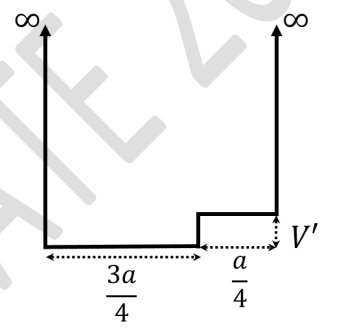
The first order energy shift of the fourth energy eigenstate due to this perturbation is
$(\frac{h^2}{Nma^2})$
The value of $N$ is ____________ (in integer).- A particle of mass $m$ in the x-y plane is confined in an infinite two-dimensional well with vertices at $(0, 0)$, $(0, L)$, $(L, L)$, $(L, 0)$. The eigenfunctions of this particle are $\Psi_{n_x,n_y} = \sin(\frac{n_x\pi x}{L}) \sin(\frac{n_y\pi y}{L})$. If perturbation of the form $V = Cxy$, where $C$ is a real constant, is applied, then which of the following statements are correct for the first excited state?
A two-level quantum system has energy eigenvalues $E_1$ and $E_2$. A perturbing potential $H' = \lambda \Delta \sigma_x$ is introduced, where $\Delta$ is a constant having dimensions of energy, $\lambda$ is a small dimensionless parameter, and $\sigma_x = \begin{pmatrix} 0 & 1 \\ 1 & 0 \end{pmatrix}$. The magnitudes of the first and the second order corrections to $E_1$ due to $H'$, respectively, are
Consider a particle in a one-dimensional infinite potential well with its walls at $x = 0$ and $x = L$. The system is perturbed as shown in the figure
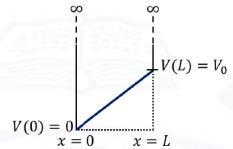
The first order correction to the energy eigenvalue is
Consider the Hamiltonian $\hat{H} = \hat{H}_0 + \hat{H}'$ where
\[\hat{H}_0 = \begin{pmatrix} E & 0 & 0 \\ 0 & E & 0 \\ 0 & 0 & E \end{pmatrix}\]and $\hat{H}$ is the time independent perturbation given by
\[\hat{H}' = \begin{pmatrix} 0 & k & 0 \\ k & 0 & k \\ 0 & k & 0 \end{pmatrix}\]where $k>0$. If, the maximum energy eigenvalue of $\hat{H}$ is 3 eV corresponding to $E=2$ eV, the value of $k$ (rounded off to three decimal places) in eV is ________.


