An art gallery engages a security guard to ensure that the items displayed are protected. The diagram below represents the plan of the gallery where the boundary walls are opaque. The location the security guard posted is identified such that all the inner space (shaded region in the plan) of the gallery is within the line of sight of the security guard.
If the security guard does not move around the posted location and has a 360° view, which one of the following correctly represents the set of ALL possible locations among the locations P, Q, R and S, where the security guard can be posted to watch over the entire inner space of the gallery.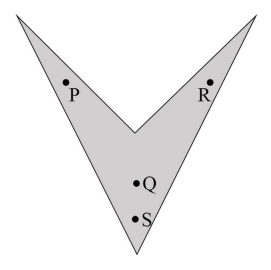
The question requires identifying the location where a security guard can be placed to oversee the entire shaded region in the gallery, with a 360° view, without moving.
Let's analyze each potential location:
- Location P:
- If the guard is posted at P, part of the area, especially the opposite wing, is not visible because of the narrow angle formed at location Q.
- Location Q:
- Being centrally located, posting the guard at Q allows visibility of both wings of the gallery and ensures the entire shaded area is within view.
- Location R:
- Similar to location P, setting the guard at R would block visibility of the opposite wing.
- Location S:
- Similar to location Q, S is also centrally located and offers a clear line of sight to the entire gallery space, just like Q.
Through this analysis, it is evident that placing the security guard at either location Q or S allows complete surveillance of the gallery. Both Q and S are centrally positioned, ensuring that all areas of the gallery are within the guard's 360° line of sight.
Conclusion: The correct set of locations where the guard can be posted is Q and S.
Important Questions from Analytical Aptitude
- The assumption that the probability of occurrence of a word in a string depends ONLY on the preceding word is called a ______ assumption.
- Which ONE of the following options represents the correct mapping of the phonetic features in Column X to their Sanskrit equivalents in Column Y?
Column X:
Phonetic featuresColumn Y:
Sanskrit termsP. voicing 1. prāṇa Q. retroflex 2. tālavya R. palatal 3. ghōṣa S. aspiration 4. mūrdhanya - Which ONE of the options represents the CORRECT mapping between the morphological concepts in Column X and the examples in Column Y?
Column X:
Morphological ConceptsColumn Y:
ExamplesP. Suppletion 1. bookmaker – bookie Q. Conversion 2. deer – deer R. Zero morpheme 3. bad – worst S. Hypocorism 4. arrive – arrival T. Derivation 5. (a) doctor – (to) doctor 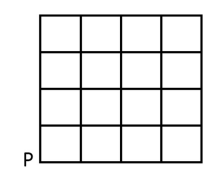
An ant is at the bottom-left corner of a grid (point P) as shown above. It aims to move to the top-right corner of the grid. The ant moves only along the lines marked in the grid such that the current distance to the top-right corner strictly decreases.
Which one of the following is a part of a possible trajectory of the ant during the movement?A building has several rooms and doors as shown in the top view of the building given below. The doors are closed initially.
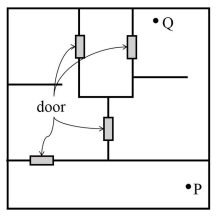
What is the minimum number of doors that need to be opened in order to go from the point P to the point Q?