An angle is observed independently twice, and the values are as follows: $60° 30^′ 10″ \pm 10"$ $60° 30^′ 20″ \pm 20″$ The most probable value (MPV) of the angle is
$60°30^′12″$
Solution: Calculating the Most Probable Value (MPV)
The Most Probable Value (MPV) is the best estimate derived from multiple independent measurements, considering the precision (error) of each measurement.
1. Identify Observations and Errors
The two independent angle observations ($V$) and their associated errors ($\sigma$) are:
- Observation 1: $V_1 = 60° 30^′ 10″$, Error $\sigma_1 = 10″$.
- Observation 2: $V_2 = 60° 30^′ 20″$, Error $\sigma_2 = 20″$.
2. Calculate Observation Weights
The weight ($w$) for each observation is determined by the inverse square of its error: $w = \frac{1}{\sigma^2}$. Higher weight means greater reliability.
- Weight for Observation 1 ($w_1$): $w_1 = \frac{1}{(10″)^2} = \frac{1}{100}$.
- Weight for Observation 2 ($w_2$): $w_2 = \frac{1}{(20″)^2} = \frac{1}{400}$.
3. Compute Weighted Mean
The MPV is calculated using the weighted arithmetic mean formula: MPV = $\frac{\sum (w_i V_i)}{\sum w_i}$
Since the degrees ($60°$) and minutes ($30^′$) are identical in both observations, we calculate the weighted mean of the seconds ($S$) component:
MPV (seconds) = $\frac{w_1 S_1 + w_2 S_2}{w_1 + w_2}$
Where $S_1 = 10″$ and $S_2 = 20″$.
4. Perform Calculation
Substitute the weights and seconds values:
MPV (seconds) = $\frac{\left(\frac{1}{100}\right) (10″) + \left(\frac{1}{400}\right) (20″)}{\frac{1}{100} + \frac{1}{400}}$
Simplify the expression:
MPV (seconds) = $\frac{\frac{10}{100}″ + \frac{20}{400}″}{\frac{4}{400} + \frac{1}{400}} = \frac{\frac{1}{10}″ + \frac{1}{20}″}{\frac{5}{400}}}$
MPV (seconds) = $\frac{\frac{2+1}{20}″}{\frac{1}{80}} = \frac{\frac{3}{20}″}{\frac{1}{80}}}$
MPV (seconds) = $\frac{3}{20} \times 80 ″ = 3 \times 4 ″ = 12″$
5. State Final MPV
Combine the common part ($60° 30^′$) with the calculated weighted mean seconds ($12″$):
The Most Probable Value (MPV) is $60° 30^′ 12″$.
Important Questions from Error Analysis
The calibration graph between absorbance and the concentration of chromate (CrO$_4^{2-}$) in a water sample is shown in the figure.
The equation of the line is $y = 0.8003x + 0.0055$.
For an absorbance of 0.35 in a water sample, the estimated Cr(VI) concentration is ______ mg/L (rounded off to two decimal places).
Use the atomic weight (g/mol) of Cr and O as 52 and 16, respectively.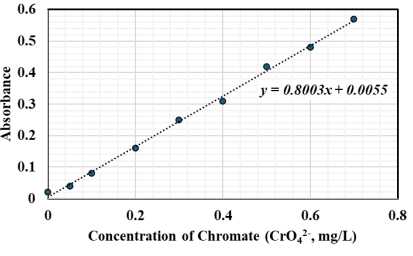
A digital counter increments its count every $0.1\ \mu\text{s}$. The counter is used in an instrument to measure frequency. The counter is operated for one period of the input signal to the instrument to measure its frequency. The input signal is approximately at $100\text{ kHz}$. The maximum error in the measured frequency is _____ kHz.
(rounded off to the nearest integer)
- The length of a highway was measured in 10 equal sections. If the precision of the individual section measurements is $\sigma$, then what is the precision of the measured length of the highway?
- A trapezoidal land parcel for a residential plot measures 10.335 m in the south, 13.971 m in the north, 5.047 m in the west and 6.302 m in the east directions. The north and south sides are perpendicular to the western side of the plot, making the eastern side skewed. Given the lengths of the sides are measured with a precision of 1 mm, the precision of the area of the plot calculated from these measurements is __________ $\text{m}^2$ (Rounded off to two decimal values).
Hint: Area of a trapezium $= \left(\frac{\text{sum of parallel sides}}{2}\right) \times \text{height}$ Identify the type of error the instrument shows as in the given figure.