1,3-Dithiane as Formyl Anion Equivalent
The question asks to identify a compound that can serve as a formyl anion equivalent using a strong base. A formyl anion has the structure $ \text{HCO}^- $. A synthetic equivalent allows chemists to achieve similar reactivity using a stable precursor.
Evaluating the Options
- Ethylene ($ \text{C}_2\text{H}_4 $): An alkene, it does not possess readily abstractable protons that can mimic a formyl anion.
- Nitroethane ($ \text{CH}_3\text{CH}_2\text{NO}_2 $): The $ \alpha $-protons are acidic due to the nitro group, forming a nitronate anion ($ \text{CH}_3\overline{\text{C}}\text{HNO}_2 $). This is not a formyl anion equivalent.
- 1,3-Dithiane: This cyclic compound features two sulfur atoms attached to the same carbon (C2). The protons on this C2 carbon are highly acidic because the adjacent sulfur atoms stabilize the resulting carbanion through inductive effects and d-orbital participation. A strong base, such as n-butyllithium (n-BuLi), readily deprotonates this position. The resulting 2-lithio-1,3-dithiane acts as a potent nucleophile. This nucleophile can react with electrophiles (e.g., alkyl halides, carbonyl compounds). Subsequent hydrolysis of the dithiane moiety (typically under acidic conditions) converts the masked carbonyl group back into an aldehyde ($ \text{CHO} $). This overall process effectively utilizes 1,3-dithiane as a precursor for introducing a formyl group, acting as a formyl anion equivalent. This chemistry is central to the Corey-Seebach reaction, enabling "umpolung" (polarity reversal) of carbonyl reactivity.
- 1,4-Dithiane: In this isomer, the sulfur atoms are separated by two carbon atoms. The protons are not significantly acidic and do not facilitate the formation of a stabilized carbanion suitable for mimicking a formyl anion.
Conclusion
1,3-dithiane is the compound that acts as a formyl anion equivalent due to the enhanced acidity of its C2 protons, allowing for nucleophilic attack after deprotonation and subsequent conversion to an aldehyde functionality.
Important Questions from Organic Synthesis
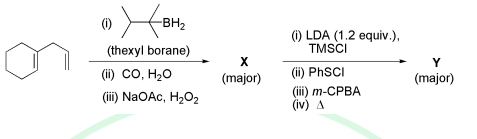
The major products X and Y formed in the following reaction sequences are
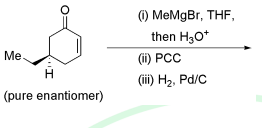
For the following reaction, the possible product(s) is/are
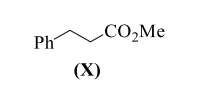
The reaction(s) that yield(s) X as the major product is (are)
The major products E and F in the following reaction sequence are
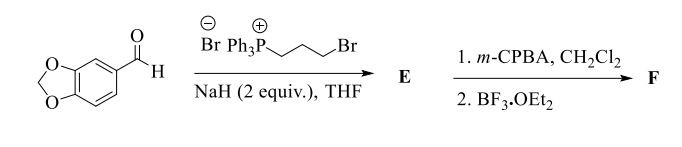
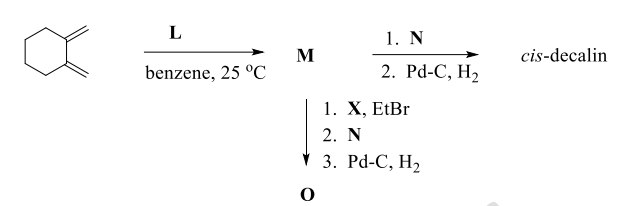
Consider the following reaction sequence. The correct option(s) is (are)