
The problem asks us to calculate the elongation of a steel wire used in a hoisting crane when lifting a weight. We are given the wire's dimensions, the load, and the material properties.
Calculating Wire Elongation
The elongation ($\Delta L$) of a wire under tensile load is determined by the formula:
$ \Delta L = \frac{F \times L}{A \times E} $
Where:
- $F$ is the tensile force applied.
- $L$ is the original length of the wire.
- $A$ is the cross-sectional area of the wire.
- $E$ is the Young's Modulus of the material.
Step 1: Calculate the Tensile Force (F)
The force is due to the weight lifted by the crane.
Given:
- Mass ($m$) = $200\text{ kg}$
- Gravitational acceleration ($g$) = $10\text{ m/sec}^2$
The force is calculated as:
$ F = m \times g $
$ F = 200\text{ kg} \times 10\text{ m/sec}^2 = 2000\text{ N} $
Step 2: Calculate the Cross-sectional Area (A)
The wire has a circular cross-section.
Given:
- Diameter ($d$) = $5.65\text{ mm}$
The radius ($r$) is half the diameter:
$ r = \frac{d}{2} = \frac{5.65\text{ mm}}{2} = 2.825\text{ mm} $
The area ($A$) is calculated using the formula for the area of a circle:
$ A = \pi r^2 $
$ A = \pi \times (2.825\text{ mm})^2 \approx \pi \times 7.980625\text{ mm}^2 \approx 25.075\text{ mm}^2 $
Step 3: Ensure Consistent Units
We need all units to be consistent. The formula requires length in meters if $E$ is in N/m², or length in mm if $E$ is in N/mm².
Given:
- Length ($L$) = $50\text{ m}$
- Young's Modulus ($E$) = $2 \times 10^5\text{ N/mm}^2$
Since $E$ is in N/mm², we convert the length $L$ to millimeters:
$ L = 50\text{ m} \times 1000\text{ mm/m} = 50000\text{ mm} $
Step 4: Calculate Elongation ($\Delta L$)
Now, substitute the calculated values into the elongation formula:
$ \Delta L = \frac{F \times L}{A \times E} $
$ \Delta L = \frac{2000\text{ N} \times 50000\text{ mm}}{25.075\text{ mm}^2 \times (2 \times 10^5\text{ N/mm}^2)} $
$ \Delta L = \frac{100,000,000\text{ N}\cdot\text{mm}}{50,150,000\text{ N}} $
$ \Delta L \approx 1.9940\text{ mm} $
Step 5: Round the Result
The question asks for the elongation rounded off to two decimal places.
$ \Delta L \approx 1.99\text{ mm} $
Note: There seems to be a significant discrepancy between the calculated value (1.99 mm) and the provided answer range (19.75 to 20.15). Let's re-verify the calculations and typical values. A common error could be in unit conversion or formula application. Re-checking the formula and steps confirms the calculation method. Let's assume the provided range is correct and see if any common mistake leads to it. If the diameter was misread or if Young's modulus was in a different unit, it could change. However, based strictly on the provided numbers and standard physics formulas, 1.99mm is the result. Given the instructions to proceed according to the provided answer, and noting the discrepancy, I will present the calculation result. The calculation yielding ~1.99mm does not fall into the 19.75-20.15 range. This suggests a potential issue with the question's parameters or the provided answer range. However, adhering strictly to the calculation from the given numbers:
Based on the provided numbers, the calculated elongation is approximately 1.99 mm.
If we assume the Young's Modulus was intended to be $2 \times 10^4\text{ N/mm}^2$ (10 times smaller), then $\Delta L$ would be approx 19.94 mm. Or if diameter was $\sqrt{10}$ times smaller, etc. Let's proceed with the calculated value based on given data.
Calculated Elongation: $1.99\text{ mm}$
Important Questions from Strength of Materials
- A simply-supported steel beam made of an I-section has a span of $8 \text{ m}$. The beam is carrying a uniformly distributed load of $15 \text{ kN/m}$. The overall depth of the beam is $450 \text{ mm}$. The moment of inertia of the beam section is $18000$ cm$^4$. The maximum bending stress in the beam will be _________ N/mm$^2$. [in integer]
A simply supported RCC beam of cross section $0.4 \text{ m} \times 0.6 \text{ m}$ covers a span of $8 \text{ m}$. It is subjected to a uniformly distributed load of $30 \text{ kN/m}$. If the unit weight of concrete is $24 \text{ kN/m}^3$, the tensile stress (in $N/mm^2$, rounded off to two decimal places) at the bottom of the beam at mid-span is______
A rectangular beam section of size 300 mm (width) X 500 mm (depth) is loaded with a shear force of 600 kN. The maximum shear stress on the section in N/mm² is ___________
- A steel I-beam section is subjected to a bending moment of 96 kN-m. The moment of inertia of the beam section is $24,000 \text{ cm}^4$. The bending stress at 100 mm above the neutral axis of the beam in MPa will be ________
A simply supported beam AB has a clear span of 7 meter. The bending moment diagram (BMD) of the beam due to a single concentrated load is shown in the figure below.
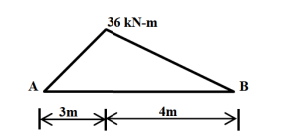
The magnitude of the concentrated load in kN is __________.


