
Fair Die Roll Scenario Analysis
The problem describes a scenario where a standard fair die is rolled repeatedly until a face value that is not 5 or 6 appears. The variable X represents the value shown on this final roll.
Determining the Sample Space for X
The rolling stops when a face from the set $\{1, 2, 3, 4\}$ is observed. This means the possible values for the final roll, X, are restricted to $\{1, 2, 3, 4\}$.
Since the die is fair, the probability of rolling any specific face is $1/6$. The probability that the process stops on any given roll is the probability of rolling a 1, 2, 3, or 4, which is $P(\text{stop}) = P(\{1, 2, 3, 4\}) = 4/6 = 2/3$.
To find the probability distribution for X, we consider the conditional probability of each outcome given that the stopping condition is met (i.e., the roll is in $\{1, 2, 3, 4\}$):
$ P(X=i \mid X \in \{1, 2, 3, 4\}) = \frac{P(X=i)}{P(X \in \{1, 2, 3, 4\})} = \frac{1/6}{4/6} = \frac{1}{4} $Therefore, the effective sample space for X consists of the outcomes $\{1, 2, 3, 4\}$, and each outcome has an equal probability of $1/4$.
Analyzing Events A and B
Event A is defined as $\{X \text{ is even}\}$. Within the sample space $\{1, 2, 3, 4\}$, the outcomes satisfying event A are $\{2, 4\}$.
Event B is defined as $\{X \text{ is at most 2}\}$. Within the sample space $\{1, 2, 3, 4\}$, the outcomes satisfying event B are $\{1, 2\}$.
Calculating the Intersection Probability $P(A \cap B)$
The intersection event $A \cap B$ requires that X satisfies both condition A (being even) and condition B (being at most 2). The only outcome from the sample space $\{1, 2, 3, 4\}$ that meets both criteria is $X=2$.
Thus, the event $A \cap B$ is equivalent to the event $\{X=2\}$.
The probability of this intersection is:
$ P(A \cap B) = P(X=2) $Based on the conditional probability distribution established earlier:
$ P(A \cap B) = \frac{1}{4} $Important Questions from Probability (Notes)
- A stick of length L is broken into two pieces at random. What is the average length of the smaller piece?
- A fair die was thrown three times and the outcome was repeatedly six. If the die is thrown again what is the probability of getting six?
A canal system is shown in the figure.
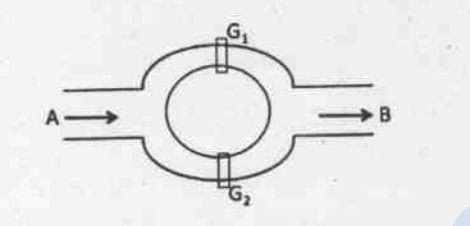
Water flows from A to B through two channels. Gates $G_1$ and $G_2$ are operated independently to regulate the flow. Probability of $G_1$ to be open is 10% while that of $G_2$ is 20%. The probability that water will flow from A to B is
Consider a Markov chain having state space $S = \{1,2,3,4\}$ with transition probability matrix $P = (p_{i,j})$ given by
$$\begin{matrix} & \begin{matrix} 1 & \quad 2 & \quad 3 & \quad 4 \end{matrix} \\ \begin{matrix} 1 \\ 2 \\ 3 \\ 4 \end{matrix} & \begin{bmatrix} 1/2 & 0 & 1/2 & 0 \\ 1/4 & 1/4 & 1/4 & 1/4 \\ 1/3 & 0 & 1/3 & 1/3 \\ 1/2 & 0 & 1/2 & 0 \end{bmatrix} \end{matrix}$$
Then- Let $X$ and $Y$ be two random variables with joint probability density function $f(x, y) = \begin{cases} \frac{1}{\pi} & \text{if } 0 \leq x^2 + y^2 \leq 1 \\ 0 & \text{otherwise.} \end{cases}$ Which of the following statements are correct?


