
A simply supported RCC beam of span 4 m is supporting a brick wall over its entire span. The brick wall is 250 mm thick and 2 m high. The RCC beam has a depth of 600 mm and width of 250 mm. The density of brick masonry and RCC can be assumed as 18 KN/m³ and 25 KN/m³ respectively. Considering the load of the wall and self-weight of the RCC beam, the maximum bending moment in the beam (in KN-m) will be ____________ [rounded off to two decimal places].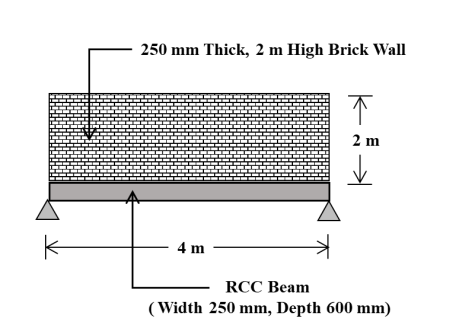
Calculation of Maximum Bending Moment
To find the maximum bending moment in the simply supported beam, we first determine the total uniformly distributed load (UDL) per meter length.
1. Identify Given Parameters and Convert to Meters
- Span of the beam ($L$): $4\text{ m}$
- Beam width ($B$): $250\text{ mm} = 0.25\text{ m}$
- Beam depth ($D$): $600\text{ mm} = 0.6\text{ m}$
- Wall height ($H_w$): $2\text{ m}$
- Wall thickness ($t_w$): $250\text{ mm} = 0.25\text{ m}$
- Density of RCC ($\rho_{\text{rcc}}$): $25\text{ kN/m}^3$
- Density of brick masonry ($\rho_{\text{brick}}$): $18\text{ kN/m}^3$
2. Calculate the Load per Unit Length ($w$)
The total UDL ($w$) is the sum of the self-weight of the RCC beam and the weight of the brick wall.
A. Self-weight of the RCC beam ($w_{\text{beam}}$):
$$w_{\text{beam}} = (\text{Width} \times \text{Depth}) \times \text{Density} = (0.25\text{ m} \times 0.6\text{ m}) \times 25\text{ kN/m}^3$$ $$w_{\text{beam}} = 0.15\text{ m}^2 \times 25\text{ kN/m}^3 = 3.75\text{ kN/m}$$
B. Weight of the brick wall ($w_{\text{wall}}$):
$$w_{\text{wall}} = (\text{Thickness} \times \text{Height}) \times \text{Density} = (0.25\text{ m} \times 2\text{ m}) \times 18\text{ kN/m}^3$$ $$w_{\text{wall}} = 0.5\text{ m}^2 \times 18\text{ kN/m}^3 = 9.00\text{ kN/m}$$
C. Total UDL ($w$):
$$w = w_{\text{beam}} + w_{\text{wall}} = 3.75 + 9.00 = 12.75\text{ kN/m}$$
3. Calculate Maximum Bending Moment ($M_{\text{max}}$)
For a simply supported beam with a UDL over its entire span, the maximum bending moment occurs at the mid-span:
$$M_{\text{max}} = \frac{wL^2}{8}$$ $$M_{\text{max}} = \frac{12.75\text{ kN/m} \times (4\text{ m})^2}{8}$$ $$M_{\text{max}} = \frac{12.75 \times 16}{8} = 12.75 \times 2$$ $$M_{\text{max}} = 25.50\text{ kN-m}$$
Conclusion
The maximum bending moment in the beam is 25.50 kN-m.
Important Questions from Design of Structural Elements
- The slenderness ratio of a circular column of diameter $300 \text{ mm}$ and effective height $3 \text{ m}$ is _________ [in integer]
- Match the structural system in Group I with their potential causes of failure in Group II
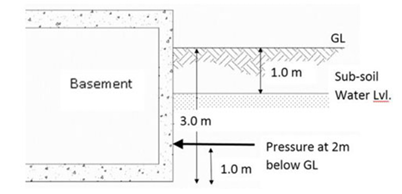
Group I Group II (P) Flat Slab (1) Thrust (Q) Long Column (2) Flutter (R) Arch (3) Punching Shear (S) Tensile Fabric (4) Buckling (5) Moment A basement wall resists lateral pressure exerted by soil and water. The soil pressure amounts to $4.5 \text{ kN/m}^2$ for every metre of depth below Ground Level (GL). The sub-soil water level is $1.0 \text{ m}$ below GL and hydrostatic pressure of water is $9.8 \text{ kN/m}^2$ for every metre of depth below GL. The total lateral pressure (in $kN/m^2$, rounded off to one decimal place) exerted on the wall $2 \text{ m}$ below GL is______
- Slenderness ratio of a column is represented as:
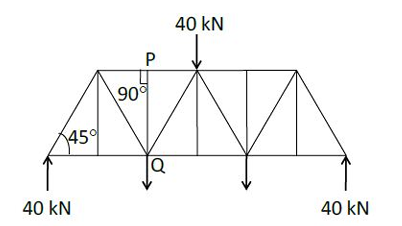
For a symmetrical two dimensional truss as shown in the above figure, vertical force in kN acting on the member PQ is ________


