
A Question is given followed by two Statements I and II. Consider the Question and the Statements. P, Q, R and S appeared in a test. Question: Has P scored more marks than Q ? Statement - I: The sum of the marks scored by P and Q is equal to the sum of the marks scored by R and S. Statement - II: The sum of the marks scored by P and S is more than the sum of the marks scored by Q and R. Which one of the following is correct in respect of the above Question and the Statements?
The Question cannot be answered even by using both the Statements together
Using statement-I alone:
P + Q = R + S ….…(i) So,
from statement –I alone we cannot say that P scored more than Q or not.
Using statement-II alone: (P + S) > (Q + R) ……..(ii) So, from statement –II alone also,
we cannot say that P scored more than Q or not.
And even after combining both the statements, we cannot definitely say that P scored more that Q or not.
Therefore, this question cannot be answered even by using both of the statements together.
Important Questions from Miscellaneous Topics
- In communication the word 'Haptics' signifies :
- Which of the following statements best defines the scope of semiotics?
The compound interest on Rs. 75,000 for three years, at successive interest rates of 4%, 6% and 9% for each year respectively is:
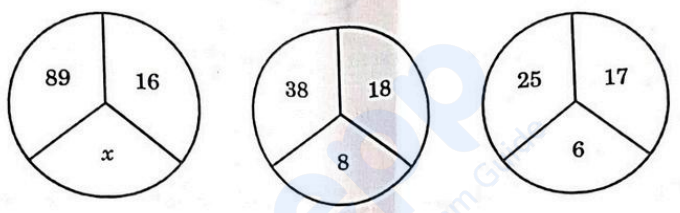
The value of x in the following figures is :
When a child reaches adolescence, there is apt to be a conflict between the parents and the child, since
the latter considers himself to be by now quite capable of managing his own affairs, while the former
are filled with parental solicitude, which is often a disguise for love of power. Parents consider, usually,
that the various moral problems which arise in adolescence are peculiarly their province. The options
they express, however, are so dogmatic that the young seldom confide in them, and usually go their
own way in secret.


