
A question is followed by two statements numbered I and II. You have to decide whether the data provided in the statements are sufficient to answer the question. Read both the statements and select the most appropriate answer.
C, I, L, N, R, and Y live on six different floors of the same building. The lowermost floor in the building is numbered 1, the floor above it is numbered 2, and so on, till the topmost floor is numbered 6. Who among them lives immediately above Y?
(I) Only four people live between N and I. C lives immediately below I.
(II) Only one person lives between C and R. Y lives immediately above N.
Building Floors and People
This problem involves determining the arrangement of six people—C, I, L, N, R, and Y—on six distinct floors of a building. The floors are numbered from 1 (the lowest) to 6 (the highest). Our objective is to find out which person lives on the floor immediately above Y. We must use the information provided in two statements to see if it's sufficient to solve this puzzle.
N and I Floors: Statement I
Statement I gives us two conditions:
- "Only four people live between N and I." This means that if we count the people on the floors strictly between N and I, there are exactly four. This implies that N and I are separated by 5 floors. If $F_N$ represents the floor number of N and $F_I$ represents the floor number of I, then the number of floors between them is $|F_N - F_I| - 1$. So, $|F_N - F_I| - 1 = 4$, which means $|F_N - F_I| = 5$. The only possible pairs of floors for N and I are (1, 6) or (6, 1).
- "C lives immediately below I." This means the floor number for C ($F_C$) is one less than the floor number for I ($F_I$). Mathematically, $F_C = F_I - 1$.
Let's consider the possible scenarios based on these conditions:
- Scenario 1: If I is on floor 6 ($F_I = 6$), then C must be on floor 5 ($F_C = 6 - 1 = 5$). To satisfy $|F_N - F_I| = 5$, N must be on floor 1 ($F_N = 1$). This gives us a partial arrangement: 6: I 5: C 4: ? 3: ? 2: ? 1: N The remaining people are L, R, and Y, who would occupy floors 2, 3, and 4. However, we do not have enough information to determine Y's specific floor, and thus we cannot find who lives immediately above Y.
- Scenario 2: If I is on floor 1 ($F_I = 1$), then C would need to be on floor 0 ($F_C = 1 - 1 = 0$). Since floor 0 does not exist in this building, this scenario is impossible.
Because we cannot determine the exact position of Y from Statement I alone, it is not sufficient to answer the question.
Y Above N: Statement II
Statement II provides the following conditions:
- "Only one person lives between C and R." This implies that C and R are on floors separated by exactly one floor. Possible floor pairs for {C, R} are {1, 3}, {2, 4}, {3, 5}, or {4, 6}, and vice versa.
- "Y lives immediately above N." This means the floor number for Y ($F_Y$) is one greater than the floor number for N ($F_N$). Mathematically, $F_Y = F_N + 1$. Possible pairs for (N, Y) are (1, 2), (2, 3), (3, 4), (4, 5), or (5, 6).
Let's test if these conditions are enough on their own:
- Consider the case where N is on floor 1 and Y is on floor 2 (N=1, Y=2). The remaining floors are 3, 4, 5, and 6. The remaining people are C, I, L, and R. We need to place C and R such that one person is between them using these floors.
- If C is on floor 3 and R is on floor 5 (with floor 4 between them), then the person above Y (floor 2) is C (floor 3).
- If R is on floor 3 and C is on floor 5 (with floor 4 between them), then the person above Y (floor 2) is R (floor 3).
Therefore, Statement II alone is not sufficient to answer the question.
Building Layout: Combined Analysis
Now, let's combine the information from both Statement I and Statement II to see if we can find a unique solution.
- From Statement I, we concluded that N must be on floor 1, C on floor 5, and I on floor 6. This is the only valid possibility derived from Statement I. Current arrangement based on Statement I: 6: I 5: C 4: ? 3: ? 2: ? 1: N
- Now, we incorporate Statement II. It states that "Y lives immediately above N" ($F_Y = F_N + 1$). Since Statement I placed N on floor 1 ($F_N = 1$), Y must be on floor 2 ($F_Y = 1 + 1 = 2$). Updated arrangement: 6: I 5: C 4: ? 3: ? 2: Y 1: N
- The remaining people are L and R, and the remaining floors are 3 and 4. Thus, L and R must occupy floors 3 and 4.
- Statement II also tells us that "Only one person lives between C and R." We know C is on floor 5 ($F_C = 5$).
- If R were on floor 4 ($F_R = 4$), then there would be zero people between C and R, which contradicts the condition.
- Therefore, R must be on floor 3 ($F_R = 3$). This places L on floor 4 ($F_L = 4$). This arrangement satisfies the condition that there is exactly one person (L on floor 4) between C (on floor 5) and R (on floor 3).
This leads to a single, complete, and consistent arrangement of all six people:
| Floor | Person |
|---|---|
| 6 | I |
| 5 | C |
| 4 | L |
| 3 | R |
| 2 | Y |
| 1 | N |
The question asks: "Who among them lives immediately above Y?"
Observing our final arrangement, Y is on floor 2. The person on floor 3, which is immediately above Y, is R.
Since combining both statements allows us to determine a unique answer, the data in both statements together is sufficient to answer the question.
People's Positions: Conclusion
Both Statement I and Statement II, when used together, provide sufficient data to solve the puzzle and determine that R lives immediately above Y.
Important Questions from Data Sufficiency (Notes)
In this question, a question is followed by two statements numbered (I) and (II). You have to decide whether the data provided in the statements are sufficient to answer the question. Read both the statements and decide the appropriate answer.
Q. Five students – Isha, Kavita, Meenal, Nisha, and Priti – scored different marks.Who scored the second highest?
(I) Meenal scored more than Isha but less than Nisha.
(II) Priti scored more than Meenal but less than Nisha.- In light of the statements I and II choose the most appropriate option.
If a group comprises of five persons A, B, C, D and E, then how many persons are taller than E?
Statement (I) A is taller than B and B is shorter than A and E only.
Statement (II) C is shorter than A and A is shorter than E. - In light of the statements I and II choose the most appropriate option.
Eight boxes- A, B, C, D, P, Q, R and S are stacked vertically but not necessarily in the same order. Which among them is kept immediately above R?
Statement (I) Only three boxes are kept above D and only one box is kept between D and Q. Q is kept lower than D and is immediately below P.
Statement (II) Only one box is kept between A and C. C is kept three boxes above Q. As many boxes are kept above B as are kept below R. - A question along with a set of statements is given. Find which of the given statements is/are sufficient to answer the given question.
Question:
Find the perimeter of a triangle given that:
Statements:
I. Area of the triangle is 24 sq. units.
II. Height of the triangle is 4 units. A question along with a set of statements is given below. We have to find which of the given statements is/are sufficient to answer the given question.
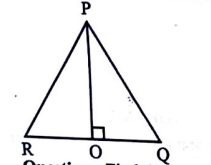
Question : Find the area of the triangle PQR.
Statements :
I. PQ = 5 m., PR = 5 m.
II. Length of PO is 4 m.


