
Question:
Find the perimeter of a triangle given that:
Statements:
I. Area of the triangle is 24 sq. units.
II. Height of the triangle is 4 units.
Sufficiency Analysis for Triangle Perimeter
The question asks if the given statements are sufficient to determine the perimeter of a triangle.
Statement I Sufficiency
- Statement I says the area of the triangle is 24 sq. units.
- Knowing only the area is insufficient to determine the side lengths and thus the perimeter. Many different triangles can have the same area. For example, a 6x8 right triangle has area 24, and a 4x12 right triangle also has area 24, but their perimeters differ.
Statement II Sufficiency
- Statement II says the height of the triangle is 4 units.
- Knowing only the height is insufficient. The height relates to a specific base, but without knowing the base or other side lengths, the perimeter cannot be found.
Combined Statements Sufficiency
- Combining both statements, we know the area ($A = 24$) and a height ($h = 4$).
- We can find the corresponding base ($b$) using the area formula: $A = \frac{1}{2} \times b \times h$.
- Substituting the values: $24 = \frac{1}{2} \times b \times 4$.
- $24 = 2 \times b$.
- $b = \frac{24}{2} = 12$ units.
- So, we know the triangle has a base of 12 units and the corresponding height is 4 units. However, this information does not uniquely define the triangle.
- Example 1: An isosceles triangle with base 12 and height 4. The equal sides would be $\sqrt{4^2 + (\frac{12}{2})^2} = \sqrt{16 + 36} = \sqrt{52}$. The perimeter would be $12 + 2\sqrt{52} = 12 + 4\sqrt{13}$ units.
- Example 2: A right-angled triangle with legs 4 and 12. The area is $\frac{1}{2} \times 4 \times 12 = 24$. The height corresponding to the base 12 is 4. The perimeter is $4 + 12 + \sqrt{4^2 + 12^2} = 16 + \sqrt{160} = 16 + 4\sqrt{10}$ units.
- Since different possible triangles yield different perimeters ($12 + 4\sqrt{13} \neq 16 + 4\sqrt{10}$), the statements combined are still not sufficient.
Conclusion
Neither statement alone, nor both statements together, provide enough information to uniquely determine the perimeter of the triangle.
Important Questions from Data Sufficiency (Notes)
In this question, a question is followed by two statements numbered (I) and (II). You have to decide whether the data provided in the statements are sufficient to answer the question. Read both the statements and decide the appropriate answer.
Q. Five students – Isha, Kavita, Meenal, Nisha, and Priti – scored different marks.Who scored the second highest?
(I) Meenal scored more than Isha but less than Nisha.
(II) Priti scored more than Meenal but less than Nisha.- In light of the statements I and II choose the most appropriate option.
If a group comprises of five persons A, B, C, D and E, then how many persons are taller than E?
Statement (I) A is taller than B and B is shorter than A and E only.
Statement (II) C is shorter than A and A is shorter than E. - In light of the statements I and II choose the most appropriate option.
Eight boxes- A, B, C, D, P, Q, R and S are stacked vertically but not necessarily in the same order. Which among them is kept immediately above R?
Statement (I) Only three boxes are kept above D and only one box is kept between D and Q. Q is kept lower than D and is immediately below P.
Statement (II) Only one box is kept between A and C. C is kept three boxes above Q. As many boxes are kept above B as are kept below R. A question along with a set of statements is given below. We have to find which of the given statements is/are sufficient to answer the given question.
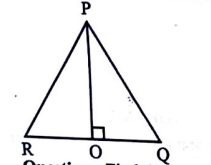
Question : Find the area of the triangle PQR.
Statements :
I. PQ = 5 m., PR = 5 m.
II. Length of PO is 4 m.Given below is a question followed by two statements, I and II, each containing some information. Decide which of the statements are sufficient to answer the question. The difference between father's age and son's age is 21 years now. What is the present age of the son?
Statements
I. After five years, the ratio of father's age to that of the son would be 5:2.
II. The sum of father's age and son's age after five years would be 66 years.


