
Five trees A, C, E, H, and V are of different heights. Which among them is the fourth tallest tree?
(I) Only one tree is shorter than C. Exactly two trees are taller than A.
(II) H is taller than E. A is taller than V.
To determine which tree is the fourth tallest among trees A, C, E, H, and V, we analyze the data provided in both statements I and II.
Statement I:
- Only one tree is shorter than C.
- Exactly two trees are taller than A.
From this statement, we can infer the following:
- Four possible positions from shortest to tallest: \([-\] C [-] [-] \ldots \)
- C is the second shortest tree, indicating there are three taller trees.
- Given that exactly two trees are taller than A, A must be the third tallest tree, ensuring there is one tree taller than C but shorter than A.
- Hence, the sequence from shortest to tallest becomes: \([-\] C [-] A [-] \ldots \)
- We can now conclude that the fourth tree, being the fourth position in this sequence, is the tallest among E, H, or V (depending on the relative heights which are not specified here).
Thus, statement I alone is sufficient to determine the fourth tallest tree.
Statement II:
- H is taller than E.
- A is taller than V.
This statement only gives relative heights without absolute positions or sequences. Therefore, it does not directly help us establish the position of the fourth tallest tree without further context.
Comparing both statements:
- Statement I provides a clearer sequential positioning of certain trees based on their heights, specifically identifying A's position relative to others.
- Statement II offers relative positions without helping to deduce exact order or the fourth position.
- Conclusively, statement I alone is sufficient, while statement II is not.
Therefore, the correct answer is: Data in Statement I alone is sufficient to answer the question while data in statement II is not.
Important Questions from Data Sufficiency (Notes)
In this question, a question is followed by two statements numbered (I) and (II). You have to decide whether the data provided in the statements are sufficient to answer the question. Read both the statements and decide the appropriate answer.
Q. Five students – Isha, Kavita, Meenal, Nisha, and Priti – scored different marks.Who scored the second highest?
(I) Meenal scored more than Isha but less than Nisha.
(II) Priti scored more than Meenal but less than Nisha.- In light of the statements I and II choose the most appropriate option.
If a group comprises of five persons A, B, C, D and E, then how many persons are taller than E?
Statement (I) A is taller than B and B is shorter than A and E only.
Statement (II) C is shorter than A and A is shorter than E. - In light of the statements I and II choose the most appropriate option.
Eight boxes- A, B, C, D, P, Q, R and S are stacked vertically but not necessarily in the same order. Which among them is kept immediately above R?
Statement (I) Only three boxes are kept above D and only one box is kept between D and Q. Q is kept lower than D and is immediately below P.
Statement (II) Only one box is kept between A and C. C is kept three boxes above Q. As many boxes are kept above B as are kept below R. - A question along with a set of statements is given. Find which of the given statements is/are sufficient to answer the given question.
Question:
Find the perimeter of a triangle given that:
Statements:
I. Area of the triangle is 24 sq. units.
II. Height of the triangle is 4 units. A question along with a set of statements is given below. We have to find which of the given statements is/are sufficient to answer the given question.
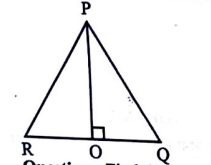
Question : Find the area of the triangle PQR.
Statements :
I. PQ = 5 m., PR = 5 m.
II. Length of PO is 4 m.


