
A paper shown in Panel I is folded along the dashed lines (- - -) to construct a cube. The shaded regions shown in Panel I appear on the outer surface of the cube. Referring to cubes shown in Panel II, which one of the options is correct? 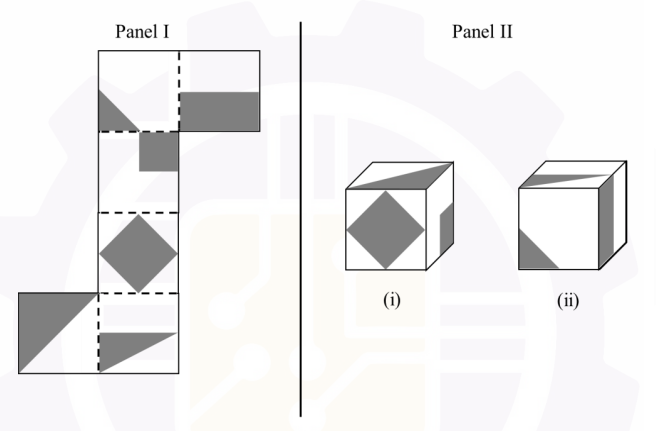
To determine which cube from Panel II corresponds to the unfolded cube in Panel I, we must analyze the arrangement of the shaded regions.
- Observe the unfolded diagram in Panel I:
- The flat pattern consists of six squares, each representing a face of the cube.
- There are three shaded regions: a dark triangle, a medium diamond, and a light triangle.
- Analyze how the cube folds:
- The central square with the medium diamond will form the face directly visible on option (i).
- The right angle triangle forms part of the top or bottom face.
- The other face must be opposite to the medium diamond or adjacent (following adjacency rules of cubes).
- Compare with the options in Panel II:
- Option (i) has the medium diamond face visible, which correctly matches the folding pattern of Panel I.
- Option (ii) shows a triangle in incorrect orientation for the given pattern.
Hence, the structure of the unfolded pattern in Panel I aligns with the cube shown in option (i) of Panel II.
Conclusion: The correct answer is: Only (i) can correspond to the unfolded cube in Panel I.
Important Questions from Paper Folding
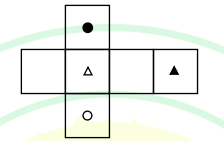
The paper as shown in the figure is folded to make a cube where each square corresponds to a particular face of the cube. Which one of the following options correctly represents the cube?
Note: The figures shown are representative.
A planar rectangular paper has two V-shaped pieces attached as shown below.
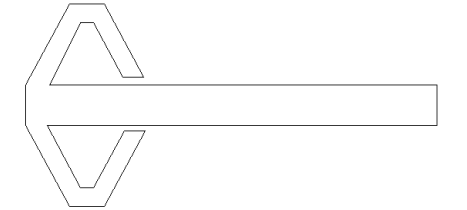
This piece of paper is folded to make the following closed three-dimensional object.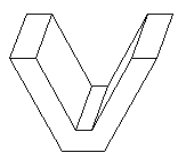
The number of folds required to form the above object isTwo identical sheets A and B, of dimensions $24$ cm $\times$ $16$ cm, can be folded into half using two distinct operations, FO1 or FO2.
In FO1, the axis of folding remains parallel to the initial long edge, and in FO2, the axis of folding remains parallel to the initial short edge.
If sheet A is folded twice using FO1, and sheet B is folded twice using FO2, the ratio of the perimeters of the final shapes of A and B is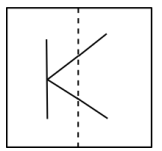
A transparent square sheet shown above is folded along the dotted line. The folded sheet will look like ________________.- Consider two rectangular sheets, Sheet M and Sheet N of dimensions 6 cm x 4 cm each.
Folding operation 1: The sheet is folded into half by joining the short edges of the current shape.
Folding operation 2: The sheet is folded into half by joining the long edges of the current shape.
Folding operation 1 is carried out on Sheet M three times.
Folding operation 2 is carried out on Sheet N three times.
The ratio of perimeters of the final folded shape of Sheet N to the final folded shape of Sheet M is ________.


