
A massless rod of length $L$ having a concentrated mass $m$ attached at its mid-point is held at rest between the smooth ground and the smooth wall when it makes an acute angle $\theta_0$ with the ground as shown. The rod is then released. The acceleration due to gravity is $g$. At an instant when the angle between the rod and ground is $\theta$, the velocity of the mass $m$ is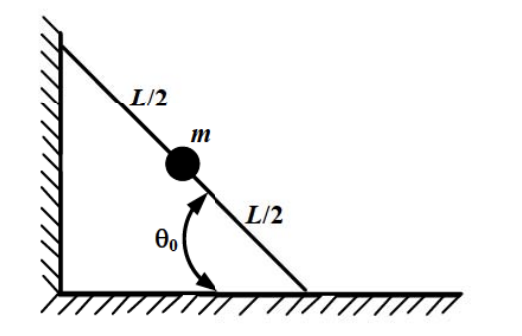
To solve this problem, we need to understand the mechanics of the system. The rod with length \(L\) is inclined at an angle \(\theta_0\) and has a mass \(m\) attached at its midpoint. The rod is initially at rest and released, meaning it will fall under the influence of gravity.
We are interested in finding the velocity of the mass at an angle \(\theta\). The problem can be approached using the principle of conservation of energy. Initially, the potential energy of the mass is maximum, and as it descends, this potential energy is converted into kinetic energy.
Step-by-step Solution:
- Calculate the initial potential energy when the rod is at angle \(\theta_0\):
\(U_{\text{initial}} = m \cdot g \cdot \frac{L}{2} \cdot \sin \theta_0\)
- Calculate the potential energy at angle \(\theta\):
\(U_{\text{final}} = m \cdot g \cdot \frac{L}{2} \cdot \sin \theta\)
- The change in potential energy is converted into kinetic energy:
\(U_{\text{initial}} - U_{\text{final}} = \frac{1}{2} m v^2\)
- Substitute the expressions for potential energies:
\(m \cdot g \cdot \frac{L}{2} (\sin \theta_0 - \sin \theta) = \frac{1}{2} m v^2\)
- Simplify the equation to solve for \(v\):
\(v = \sqrt{gL(\sin \theta_0 - \sin \theta)}\)
Thus, the velocity of the mass \(m\) when the rod makes an angle \(\theta\) with the ground is \(\sqrt{gL(\sin \theta_0 - \sin \theta)}\).
Conclusion: The correct answer is
$\sqrt{gL(\sin \theta_0 - \sin \theta)}$
.
Important Questions from Algebra
- For positive non-zero real variables $x$ and $y$, if
$ln\left(\frac{x+y}{2}\right) = \frac{1}{2} [ln\left(x\right) + ln\left(y\right)]$
then, the value of $\frac{x}{y} + \frac{y}{x}$ is Given $f(x, y) = x^2 - 2xy + y^2$
The complete contour of the equation $f(x, y) = 1$ is described by the option(s) ___.
- It is given that $x$ and $y$ are integers in the following equation:
$$(x + y - 7)^2 + (y + 3x - 13)^2 = 0$$
The value of $(x^3 + y^3)$ is ________ (in integer). - If $pqr \neq 0$ and $p^{-x} = \frac{1}{q}$, $q^{-y} = \frac{1}{r}$, $r^{-z} = \frac{1}{p}$, what is the value of the product $xyz$?
- Two points $(4, p)$ and $(0, q)$ lie on a straight line having a slope of $3/4$. The value of $(p – q)$ is


