
A hypothetical truss comprising of weightless members is shown in the following Figure. Assuming tension to be positive and compression to be negative, the value of force in member TU (in kN, rounded off to one decimal place) is ___________.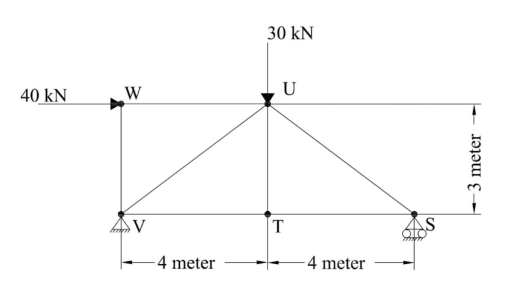
Step 1: Geometry and Loads
Span:
$VT = 4 \text{ m}$
$TS = 4 \text{ m}$
Height:
$UW = 3 \text{ m}$
Loads:
At $W$: $40 \text{ kN}$ (horizontal)
At $U$: $30 \text{ kN}$ (vertical downward)
Supports:
$V$ → pin
$S$ → roller
Step 2: Global Equilibrium
Take moments about $V$:
$8R_S - 30(4) - 40(3) = 0$
$8R_S - 120 - 120 = 0$
$8R_S = 240$
$R_S = 30 \text{ kN}$
Vertical equilibrium:
$R_V + 30 - 30 = 0$
$R_V = 0$
Horizontal equilibrium:
$H_V = 40 \text{ kN}$
Step 3: Joint T
At joint $T$, members meeting:
$VT$, $TS$, and $TU$
There is no external load at T.
Since $R_V = 0$, member $VT$ carries no vertical force.
Thus at joint $T$:
Only possible vertical force is in member $TU$.
For equilibrium:
$F_{TU} = 0$
Final Answer
$\boxed{0.0 \text{ kN}}$
(Member TU is a zero-force member.)
Important Questions from Design of Structural Elements
- The slenderness ratio of a circular column of diameter $300 \text{ mm}$ and effective height $3 \text{ m}$ is _________ [in integer]
- Match the structural system in Group I with their potential causes of failure in Group II
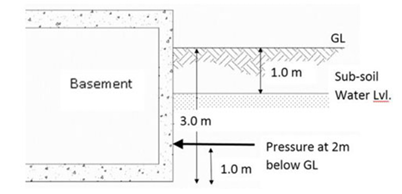
Group I Group II (P) Flat Slab (1) Thrust (Q) Long Column (2) Flutter (R) Arch (3) Punching Shear (S) Tensile Fabric (4) Buckling (5) Moment A basement wall resists lateral pressure exerted by soil and water. The soil pressure amounts to $4.5 \text{ kN/m}^2$ for every metre of depth below Ground Level (GL). The sub-soil water level is $1.0 \text{ m}$ below GL and hydrostatic pressure of water is $9.8 \text{ kN/m}^2$ for every metre of depth below GL. The total lateral pressure (in $kN/m^2$, rounded off to one decimal place) exerted on the wall $2 \text{ m}$ below GL is______
- Slenderness ratio of a column is represented as:
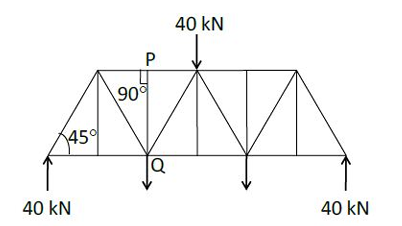
For a symmetrical two dimensional truss as shown in the above figure, vertical force in kN acting on the member PQ is ________


