
A block of 50 kg mass is on an inclined plane. The block is connected to another hanging mass M by an inextensible massless string through two massless pulleys as shown in the figure below. The coefficient of static friction between the block and the inclined plane is 0.3. Neglecting pulley friction, the minimum value of M required to start the upward motion of the block is ________ kg (rounded off to 1 decimal place).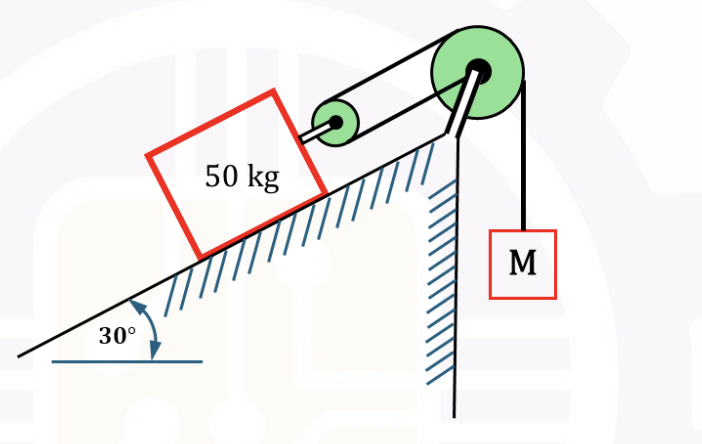
Step 1: Understand pulley system
The small pulley is attached to the block → it is a movable pulley
So, the block is pulled by two tensions:
Total pull on block = $2T$
Step 2: Forces on block (along incline)
Weight component down the plane:
$ 50g \sin 30^\circ = 50g \times \frac{1}{2} = 25g $
Normal reaction:
$ N = 50g \cos 30^\circ = 50g \times \frac{\sqrt{3}}{2} $
Friction (opposing upward motion):
$ f = \mu N = 0.3 \times 50g \times \frac{\sqrt{3}}{2} $
Step 3: Condition for upward motion
$ 2T = 25g + 0.3 \times 50g \times \frac{\sqrt{3}}{2} $
Simplify:
$ 2T = 25g + 15g \times \frac{\sqrt{3}}{2} $
Step 4: Relation with hanging mass
$ T = Mg $
So:
$ 2Mg = 25g + \frac{15\sqrt{3}}{2}g $
Cancel $g$:
$ 2M = 25 + \frac{15\sqrt{3}}{2} $
Step 5: Solve for $M$
$ M = \frac{1}{2}\left(25 + \frac{15\sqrt{3}}{2}\right) $
$ \sqrt{3} \approx 1.732 $
$ M = \frac{1}{2}(25 + 12.99) = \frac{37.99}{2} \approx 19.0 $
Final Answer:
$\boxed{19.0 \text{ kg}}$
Important Questions from Equilibrium and Friction
If in a planar system, only 2 reaction forces are acting, then the system is:-
By applying the static equations i.e. ∑H = 0, ∑V = 0 and ∑M = 0. To a determine structure, we may determine:
Which of the following is not a type of equilibrium?
Varingon’s theorem of moments states that if a number of coplanar forces acting on a particle are in equilibrium, then
A block of mass 4√2 kg is at rest on the inclined plane. The inclined plane is inclined at an angle of 135° from horizontal direction in anticlockwise direction. Determine the coefficient of friction so that block can start slide in downward direction, assume the acceleration of gravity as 10 m/s2.


