
In some code, letters P, Q, R, S, T represent numbers 4, 5, 10, 12, 15. It is not known which
letter represents which number. If Q – S = 2S and T = R + S + 3, then what is the value of P +
R – T?
(a) 2
Understanding the Letter-Number Mapping Problem
The problem asks us to find the value of an expression involving letters that represent specific numbers from a given set. We are told that the letters P, Q, R, S, and T correspond to the numbers 4, 5, 10, 12, and 15, but the exact correspondence is not initially known. We are provided with two equations that relate these letters, which will help us determine which letter represents which number.
- The set of numbers available is \(\{4, 5, 10, 12, 15\}\).
- The letters are P, Q, R, S, T.
- The given equations are $Q - S = 2S$ and $T = R + S + 3$.
- Our goal is to find the specific number each letter represents and then calculate the value of the expression $P + R - T$.
Analyzing the First Equation: Q - S = 2S
Let's start by simplifying the first equation provided:
$Q - S = 2S$
To solve for Q, we can add S to both sides of the equation:
$Q = 2S + S$
$Q = 3S$
This simplified equation tells us that the number represented by Q must be exactly three times the number represented by S. Since Q and S must be distinct numbers from the set \(\{4, 5, 10, 12, 15\}\), we can test possible values for S from this set and see if the resulting value for Q (which is $3S$) is also in the set and different from the chosen S.
- If we assume $S=4$, then $Q = 3 \times 4 = 12$. Both 4 and 12 are in the set \(\{4, 5, 10, 12, 15\}\). This is a possible pair (S, Q) = (4, 12).
- If we assume $S=5$, then $Q = 3 \times 5 = 15$. Both 5 and 15 are in the set \(\{4, 5, 10, 12, 15\}\). This is another possible pair (S, Q) = (5, 15).
- If we assume $S=10$, then $Q = 3 \times 10 = 30$. The number 30 is not in the set \(\{4, 5, 10, 12, 15\}\). This case is not possible.
- If we assume $S=12$, then $Q = 3 \times 12 = 36$. The number 36 is not in the set \(\{4, 5, 10, 12, 15\}\). This case is not possible.
- If we assume $S=15$, then $Q = 3 \times 15 = 45$. The number 45 is not in the set \(\{4, 5, 10, 12, 15\}\). This case is not possible.
Based on the first equation, we have identified two possible assignments for the letters S and Q: either S=4 and Q=12, or S=5 and Q=15.
Analyzing the Second Equation: T = R + S + 3
Now we will use the second equation, $T = R + S + 3$, to determine which of the two cases for (S, Q) is correct and to find the values of R and T. Remember that P, Q, R, S, and T must represent the five distinct numbers from the set \(\{4, 5, 10, 12, 15\}\).
Case 1: Assuming S = 4 and Q = 12
If S is 4 and Q is 12, these two numbers are used. The numbers remaining in the set \(\{4, 5, 10, 12, 15\}\) for the letters P, R, and T are \(\{5, 10, 15\}\).
Substitute $S=4$ into the second equation $T = R + S + 3$:
$T = R + 4 + 3$
$T = R + 7$
We need to find values for R and T from the remaining set \(\{5, 10, 15\} \)such that T is exactly 7 greater than R. Let's test each number in the remaining set as a potential value for R:
- If $R=5$, then $T = 5 + 7 = 12$. However, 12 is already assigned to Q in this case. T must be a number from the remaining set \(\{5, 10, 15\}\). Since 12 is not in this remaining set, R cannot be 5.
- If $R=10$, then $T = 10 + 7 = 17$. The number 17 is not in the original set of numbers \(\{4, 5, 10, 12, 15\}\), so it cannot be represented by any letter. Thus, R cannot be 10.
- If $R=15$, then $T = 15 + 7 = 22$. The number 22 is not in the original set of numbers \(\{4, 5, 10, 12, 15\}\), so it cannot be represented by any letter. Thus, R cannot be 15.
Since none of the numbers in the remaining set \(\{5, 10, 15\}\) can be assigned to R to find a valid T within that same set, the assumption that S=4 and Q=12 must be incorrect.
Case 2: Assuming S = 5 and Q = 15
If S is 5 and Q is 15, these two numbers are used. The numbers remaining in the set \(\{4, 5, 10, 12, 15\} \) for the letters P, R, and T are \(\{4, 10, 12\}\).
Substitute $S=5$ into the second equation $T = R + S + 3$:
$T = R + 5 + 3$
$T = R + 8$
We need to find values for R and T from the remaining set \(\{4, 10, 12\}\) such that T is exactly 8 greater than R. Let's test each number in the remaining set as a potential value for R:
- If $R=4$, then $T = 4 + 8 = 12$. Both 4 and 12 are in the remaining set \{4, 10, 12\}. This is a possible assignment (R, T) = (4, 12) for this case.
- If $R=10$, then $T = 10 + 8 = 18$. The number 18 is not in the original set of numbers \(\{4, 5, 10, 12, 15\}\). Thus, R cannot be 10.
- If $R=12$, then $T = 12 + 8 = 20$. The number 20 is not in the original set of numbers \(\{4, 5, 10, 12, 15\}\). Thus, R cannot be 12.
In this case (S=5, Q=15), we found exactly one valid assignment for R and T from the remaining numbers: R=4 and T=12. This case provides a consistent mapping for S, Q, R, and T.
Determining the Unique Mapping for P, Q, R, S, T
Since Case 1 did not yield a valid assignment for R and T using the remaining numbers, and Case 2 did, the mapping from Case 2 must be the correct one:
- S = 5
- Q = 15
- R = 4
- T = 12
The numbers assigned so far are 5, 15, 4, and 12. These correspond to the set \(\{4, 5, 12, 15\}\). The original set of numbers available is \(\{4, 5, 10, 12, 15\}\). The letter P must be assigned the number from the original set that has not yet been used.
The number not used is 10.
Therefore, P = 10.
The complete and unique mapping of letters to numbers is:
| Letter | Number |
|---|---|
| P | 10 |
| Q | 15 |
| R | 4 |
| S | 5 |
| T | 12 |
Calculating the Value of P + R - T
Now that we know the specific number each letter represents, we can calculate the value of the expression $P + R - T$.
We have:
$P = 10$
$R = 4$
$T = 12$
Substitute these values into the expression:
$P + R - T = 10 + 4 - 12$
$P + R - T = 14 - 12$
$P + R - T = 2$
The value of the expression $P + R - T$ is 2.
Comparing the Result with Options
Let's compare our calculated value with the given options:
- (a) 2
- (b) 1
- (c) 3
- (d) Cannot be determined due to insufficient data
Our calculated value of 2 matches option (a).
Revision Table: Steps to Solve Mapping Problems
| Step | Action Taken | Relevant Equation/Information |
|---|---|---|
| 1 | List the available numbers and letters. | \(\{4, 5, 10, 12, 15\}\) for P, Q, R, S, T |
| 2 | Simplify the first equation to find relationships between letters. | $Q - S = 2S \implies Q = 3S$ |
| 3 | Identify possible pairs of values for letters based on the simplified equation and the available numbers. | (S, Q) could be (4, 12) or (5, 15) |
| 4 | Use the second equation and the set of numbers remaining after assigning the first pair. | $T = R + S + 3$ |
| 5 | Test each possible case from Step 3. For each case, try to assign values to the other letters from the remaining numbers that satisfy the second equation. | Case 1 (S=4, Q=12): Remaining \(\{5, 10, 15\}\). $T=R+7$. No valid R, T pair from remaining numbers. |
| 6 | Continue testing cases until a valid and unique mapping is found for the letters using the available numbers. | Case 2 (S=5, Q=15): Remaining \(\{4, 10, 12\}\). $T=R+8$. Valid R=4, T=12 found from remaining numbers. |
| 7 | Assign the last remaining number to the last unassigned letter. | P = 10 (the number left in \(\{4, 5, 10, 12, 15\}\)) |
| 8 | Calculate the value of the required expression using the determined values. | $P + R - T = 10 + 4 - 12 = 2$ |
Additional Information: Logic Puzzles and Unique Solutions
This question is an example of a logic puzzle combined with basic algebra. The key to solving it is systematically using the given constraints (the equations and the set of numbers) to narrow down the possibilities for the letter-number mapping. Each equation provides a relationship that must hold true for the assigned numbers.
When working through potential assignments (like the cases for S and Q), it's important to always check against the set of remaining numbers for the other letters. The fact that each letter must map to a distinct number from the set is a crucial constraint that helps eliminate incorrect possibilities.
In this problem, the constraints were strong enough to lead to a single unique mapping of all five letters to the five numbers. If the constraints were weaker, there might have been multiple possible mappings, and the problem might have asked for a range of values or indicated that the value could not be uniquely determined.
Important Questions from Miscellaneous Topics
- In communication the word 'Haptics' signifies :
- Which of the following statements best defines the scope of semiotics?
The compound interest on Rs. 75,000 for three years, at successive interest rates of 4%, 6% and 9% for each year respectively is:
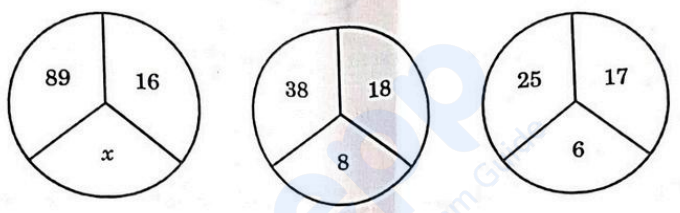
The value of x in the following figures is :
When a child reaches adolescence, there is apt to be a conflict between the parents and the child, since
the latter considers himself to be by now quite capable of managing his own affairs, while the former
are filled with parental solicitude, which is often a disguise for love of power. Parents consider, usually,
that the various moral problems which arise in adolescence are peculiarly their province. The options
they express, however, are so dogmatic that the young seldom confide in them, and usually go their
own way in secret.


