
Bending Moment Calculation for Cantilever Beam
The problem asks for the bending moment at the fixed (left) end of a cantilever beam.
Beam Setup:
- Type: Cantilever beam (fixed at one end, free at the other).
- Length: 6m.
- Fixed End: Left end.
- Free End: Right end.
Load Details:
- Load Type: Concentrated load.
- Magnitude ($P$): 25 kN (acting downwards).
- Position: 4m from the left (fixed) end.
Calculating Bending Moment at Fixed End
The bending moment at the fixed end of a cantilever beam is caused by the loads applied to the free portion of the beam. The moment is calculated as the product of the load and its perpendicular distance from the fixed end.
Let the fixed end be point A (at 0m). The load $P$ is applied at a distance $x$ from the fixed end.
Distance of the load from the fixed end ($x$): 4m
Load ($P$): 25 kN
The bending moment ($M_A$) at the fixed end (A) is calculated using the formula:
$ M_A = P \times x $
Substitute the values:
$ M_A = 25 \, \text{kN} \times 4 \, \text{m} $
$ M_A = 100 \, \text{kNm} $
The bending moment at the left end (fixed end) is 100 kNm. The downward load typically causes a hogging moment (often considered negative), but the magnitude is 100 kNm.
Important Questions from Strength of Materials
- A simply-supported steel beam made of an I-section has a span of $8 \text{ m}$. The beam is carrying a uniformly distributed load of $15 \text{ kN/m}$. The overall depth of the beam is $450 \text{ mm}$. The moment of inertia of the beam section is $18000$ cm$^4$. The maximum bending stress in the beam will be _________ N/mm$^2$. [in integer]
A simply supported RCC beam of cross section $0.4 \text{ m} \times 0.6 \text{ m}$ covers a span of $8 \text{ m}$. It is subjected to a uniformly distributed load of $30 \text{ kN/m}$. If the unit weight of concrete is $24 \text{ kN/m}^3$, the tensile stress (in $N/mm^2$, rounded off to two decimal places) at the bottom of the beam at mid-span is______
A rectangular beam section of size 300 mm (width) X 500 mm (depth) is loaded with a shear force of 600 kN. The maximum shear stress on the section in N/mm² is ___________
- A steel I-beam section is subjected to a bending moment of 96 kN-m. The moment of inertia of the beam section is $24,000 \text{ cm}^4$. The bending stress at 100 mm above the neutral axis of the beam in MPa will be ________
A simply supported beam AB has a clear span of 7 meter. The bending moment diagram (BMD) of the beam due to a single concentrated load is shown in the figure below.
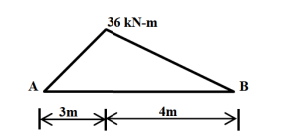
The magnitude of the concentrated load in kN is __________.


