
A 100 cm $\times$ 32 cm rectangular sheet is folded 5 times. Each time the sheet is folded, the long edge aligns with its opposite side. Eventually, the folded sheet is a rectangle of dimensions 100 cm $\times$ 1 cm.
The total number of creases visible when the sheet is unfolded is ______________.
Understanding the Folding Process
The problem involves a rectangular sheet folded multiple times. The key information is the number of folds (5) and how the folds are made ("long edge aligns with its opposite side"). This method means each fold effectively halves the dimension perpendicular to the fold.
- Fold 1: Creates 1 crease. Total creases = 1.
- Fold 2: The existing sheet is folded again. This action creates 2 new creases. Total creases = 1 + 2 = 3.
- Fold 3: Folding the sheet again creates 4 new creases. Total creases = 3 + 4 = 7.
- Fold 4: Creates 8 new creases. Total creases = 7 + 8 = 15.
- Fold 5: Creates 16 new creases. Total creases = 15 + 16 = 31.
Notice that the dimensions (100 cm $\times$ 32 cm initially, 100 cm $\times$ 1 cm finally) confirm the folding happens across the 32 cm dimension, but they are not directly needed for calculating the creases.
Crease Calculation Formula
For a sheet folded $N$ times using this method, the total number of creases formed is given by the formula:
$ \text{Total Creases} = 2^N - 1 $
This formula arises because each fold adds twice the number of creases added by the previous fold, following a pattern of $1, 2, 4, 8, \dots, 2^{N-1}$ new creases at each step.
Final Calculation
In this specific problem, the sheet is folded 5 times, so $N = 5$. Applying the formula:
$ \text{Total Creases} = 2^5 - 1 $
$ \text{Total Creases} = 32 - 1 $
$ \text{Total Creases} = 31 $
Therefore, there are 31 creases visible when the sheet is unfolded.
Important Questions from Paper Folding
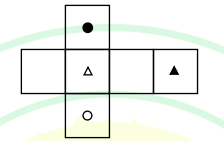
The paper as shown in the figure is folded to make a cube where each square corresponds to a particular face of the cube. Which one of the following options correctly represents the cube?
Note: The figures shown are representative.
A planar rectangular paper has two V-shaped pieces attached as shown below.
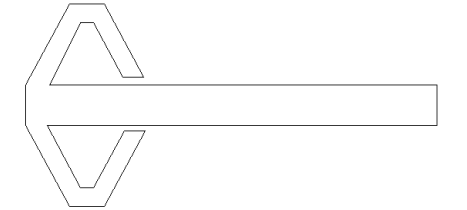
This piece of paper is folded to make the following closed three-dimensional object.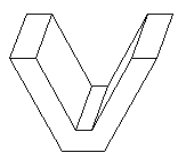
The number of folds required to form the above object isTwo identical sheets A and B, of dimensions $24$ cm $\times$ $16$ cm, can be folded into half using two distinct operations, FO1 or FO2.
In FO1, the axis of folding remains parallel to the initial long edge, and in FO2, the axis of folding remains parallel to the initial short edge.
If sheet A is folded twice using FO1, and sheet B is folded twice using FO2, the ratio of the perimeters of the final shapes of A and B is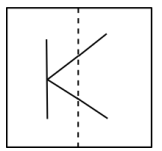
A transparent square sheet shown above is folded along the dotted line. The folded sheet will look like ________________.- Consider two rectangular sheets, Sheet M and Sheet N of dimensions 6 cm x 4 cm each.
Folding operation 1: The sheet is folded into half by joining the short edges of the current shape.
Folding operation 2: The sheet is folded into half by joining the long edges of the current shape.
Folding operation 1 is carried out on Sheet M three times.
Folding operation 2 is carried out on Sheet N three times.
The ratio of perimeters of the final folded shape of Sheet N to the final folded shape of Sheet M is ________.


