
60 students participated in one or more of the three competitions, i. e. Quiz, Extempore and Debate. A total of 22 students participated either in Quiz only or in Extempore only. 4 students participated in all three competitions. A total of 14 students participated in any of the two competitions only. How many students participated in Debated only?
20
Understanding Student Participation in Competitions
This problem involves analyzing student participation in three different competitions: Quiz, Extempore, and Debate. We are given information about the number of students participating in various combinations of these competitions and need to find the number of students who participated only in the Debate competition.
Breaking Down the Student Participation Data
Let's denote the sets of students participating in Quiz, Extempore, and Debate as Q, E, and D, respectively. The total number of students is 60, and each student participated in at least one competition. This means the total number of students is the size of the union of the three sets: $|Q \cup E \cup D| = 60$.
The total number of students participating in one or more competitions can be divided into categories based on the exact number of competitions they participated in:
- Students who participated in only one competition (Quiz only, Extempore only, or Debate only).
- Students who participated in exactly two competitions (Quiz and Extempore only, Extempore and Debate only, or Quiz and Debate only).
- Students who participated in all three competitions (Quiz, Extempore, and Debate).
The sum of students in these mutually exclusive categories equals the total number of students who participated in one or more competitions.
$$|Q \cup E \cup D| = |Q \text{ only}| + |E \text{ only}| + |D \text{ only}| + |(Q \cap E) \text{ only}| + |(E \cap D) \text{ only}| + |(Q \cap D) \text{ only}| + |Q \cap E \cap D|$$Analyzing the Given Information
We are given the following specific values:
- Total students $|Q \cup E \cup D| = 60$.
- Students participated either in Quiz only or in Extempore only: $|Q \text{ only}| + |E \text{ only}| = 22$.
- Students participated in all three competitions: $|Q \cap E \cap D| = 4$.
- Students participated in any of the two competitions only: $|(Q \cap E) \text{ only}| + |(E \cap D) \text{ only}| + |(Q \cap D) \text{ only}| = 14$.
We want to find the number of students who participated in Debate only, which is $|D \text{ only}|$.
| Participation Type | Number of Students |
|---|---|
| Total (One or More) | 60 |
| Quiz only + Extempore only | 22 |
| Exactly Two Competitions Only | 14 |
| All Three Competitions | 4 |
| Debate Only | ? (Unknown) |
Calculating Students in Debate Only
Using the principle that the total number of students is the sum of students in each distinct region of the Venn diagram, we can write the equation:
$$|Q \cup E \cup D| = (|Q \text{ only}| + |E \text{ only}|) + |D \text{ only}| + (|\text{Exactly Two Only}|) + |Q \cap E \cap D|$$Substitute the known values into this equation:
$$60 = 22 + |D \text{ only}| + 14 + 4$$Now, let's simplify the equation by adding the known numbers on the right side:
$$60 = (22 + 14 + 4) + |D \text{ only}|$$ $$60 = 40 + |D \text{ only}|$$To find the number of students who participated in Debate only, subtract 40 from 60:
$$|D \text{ only}| = 60 - 40$$ $$|D \text{ only}| = 20$$Therefore, 20 students participated only in the Debate competition.
Conclusion on Competition Participation
Based on the provided data and calculation, the number of students who participated in Debate only is 20.
Revision Table: Competition Participation Analysis
| Category | Description | Value |
|---|---|---|
| Total Participants | Participated in ≥ 1 competition | 60 |
| Quiz Only + Extempore Only | Participated in exactly 1 of these two | 22 |
| Exactly Two Only | Participated in any 2 competitions only | 14 |
| All Three | Participated in Quiz, Extempore, AND Debate | 4 |
| Debate Only (Calculated) | Participated in Debate only | 20 |
Additional Information: Venn Diagrams and Set Theory Basics
This problem is a classic example that can be solved using the principles of set theory, specifically Venn diagrams. A Venn diagram visually represents sets and their relationships, including intersections and unions.
- Union ($A \cup B \cup C$): Represents the total number of elements in sets A, B, or C, covering all regions within the circles. In this problem, it's the total number of students who participated in at least one competition.
- Intersection ($A \cap B \cap C$): Represents the elements common to all sets A, B, and C. In this problem, it's the students who participated in all three competitions.
- Region "Only": Refers to elements that belong exclusively to one set or the intersection of a specific combination of sets, excluding elements from other sets. For example, "Debate only" means students in Debate but not in Quiz or Extempore. "Quiz and Extempore only" means students in both Quiz and Extempore but not in Debate.
The formula used to solve this problem leverages the idea that the total in the union is the sum of the counts in each distinct region (only one, exactly two, exactly three). This approach avoids the complexity of the full Principle of Inclusion-Exclusion formula for three sets ($|A \cup B \cup C| = |A| + |B| + |C| - (|A \cap B| + |B \cap C| + |A \cap C|) + |A \cap B \cap C|$) by working directly with the counts of the specific regions defined in the problem.
Similar Questions
Study the given diagram carefully and answer the question that follows. The numbers in different sections indicate the number of persons who can drive different vehicles.
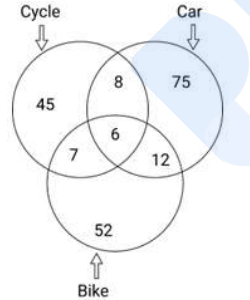
What is the difference between the number of persons who can drive all the three vehicles and that of persons who can drive any two of these vehicles?
In a group of 110 students, 23 students did not participate in any of the two games: Badminton and Chess. 45 students participated in Badminton and 61 students participated in Chess. How many students participated in Badminton only?
In a class of 100 students, every student has passed in one or more of the three subjects, i.e History, Economics and English. Among all the student, 24 students have passed in English only, 14 students have passed in History only 11 students have passed in both English and Economics only, and 12 students have passed in both English and History only. A total of 50 students have passed in History. If only 5 students have passed in all three subjects, then how many students have passed in Economies only?
Important Questions from Venn Diagram Problems
In a class of 75 students, 40 students participate in Cricket, 28 students participate in Hockey, and 12 students participate in both Cricket and Hockey, whereas 19 students do not participate in any of the two sports. How many students participate only in Hockey?
How many students like french?
A. 30
B. 35
C. 40
D. 45
What is the ratio of students who like Spanish to those who like German?
A. 2/3
B. 1/2
C. 3/2
D. 4/9
How many students like only one language?
A. 65
B. 70
C. 75
D. 85
L and A are classmates as well as good friends. In a class of 30 students, L has 10 unique friends and 5 friends who are common to A. A has a total of 17 friends in the class. How many students are friends with neither L nor A?



